USAID DEC
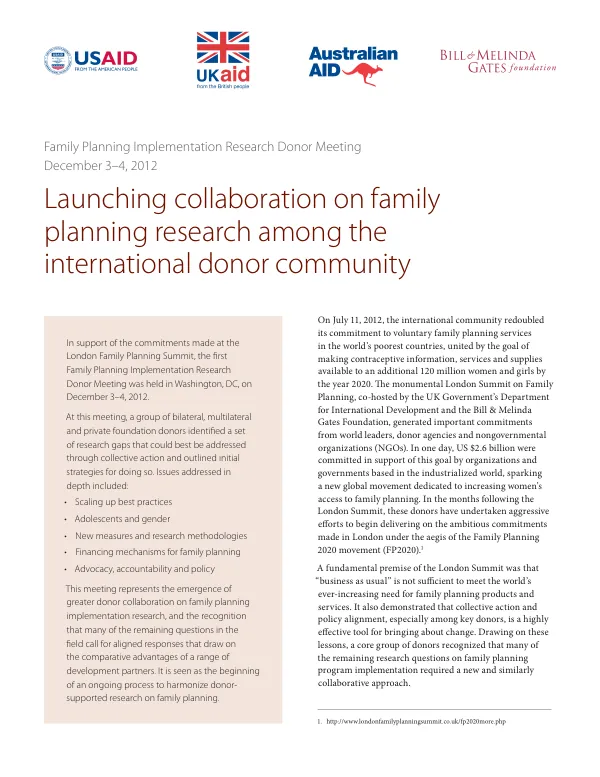
Family Planning Implementation Research Donor Meeting: Launching collaboration on family planning research among the international donor community
Sign inPOPULATION COUNCIL
Family Planning Implementation Research Donor Meeting: Launching collaboration on family planning research among the international donor community
The Family Planning Implementation Research Donor Meeting was held in Washington, DC on December 3-4, 2012.
2012 · 5 pages
Sign in to readA free account is required to download.
Abstract
The meeting brought together representatives from over 40 funding agencies to discuss knowledge gaps in family planning-service provision, scale-up, and sustainability. The group identified a set of research gaps that could be addressed through collective action and outlined initial strategies for doing so. The meeting was held in support of the Family Planning 2020 (FP2020) movement, which aims to increase access to family planning services for an additional 120 million women and girls by 2020. The FP2020 movement was launched at the London Summit on Family Planning in July 2012, where world leaders, donor agencies, and NGOs committed to increasing access to family planning services. The meeting focused on identifying research gaps in areas such as scaling up best practices, adolescents and youth, new measures and research methodologies, financing for family planning, and advocacy, accountability, and policy. The group also discussed the importance of harmonizing donor-supported research on family planning and the need for a collaborative approach to addressing the remaining research questions. The World Health Organization (WHO) presented the results of two global research priority-setting exercises, one on family planning and another on adolescents' reproductive and sexual health. Both exercises used a process developed by the Child Health and Nutrition Research Initiative (CHNRI) to rank research topics. The exercises identified a high degree of consensus around the need for research to address unmet need, including strategies for integrating family planning with other services, reaching underserved populations, and undertaking implementation research to improve the quality of family planning-service delivery. The Population Council prepared a background paper that reviewed and synthesized the large body of existing family planning research, identifying a set of key knowledge gaps in family planning research. The paper reviewed both proximate and distal factors that contribute to the complex outcome of reducing unintended pregnancy, with a focus on equity and the extent to which the needs of those most disadvantaged have been addressed in family planning programs. The paper also provided a snapshot of current and planned donor investments on family planning research, highlighting potential synergies among donors. The analysis found that the geographic focus for most participating donors is on sub-Saharan Africa and South Africa, with relatively limited research being done in Francophone West Africa. Common research issues addressed by several donors include adolescent/youth programming, integration of family planning services with other health services, health systems, and community-based approaches. The Population Council also highlighted the diversity of approaches used by donors to determine the quality of evidence, recognizing that these approaches use different standards and sources of information to determine "best practices." They emphasized the importance of investing in research that employs the most rigorous methods possible, can collect robust data, builds capacity for research, and builds the skills of decision-makers for using evidence.
Related documents