USAID DEC
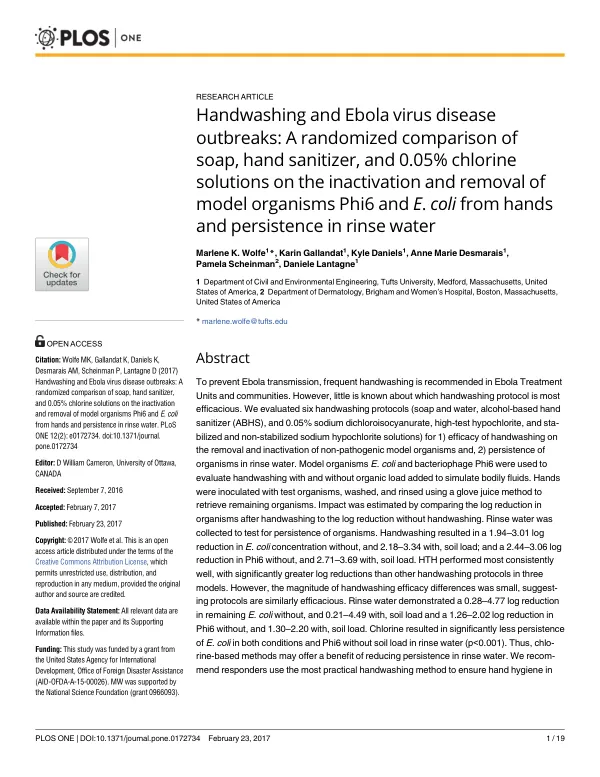
Handwashing and Ebola virus disease outbreaks: A randomized comparison of soap, hand sanitizer, and 0.05% chlorine solutions on the inactivation and removal of model organisms Phi6 and E. coli from hands and persistence in rinse water
Sign inUNIVERSITÉ DE TUFTS
Handwashing and Ebola virus disease outbreaks: A randomized comparison of soap, hand sanitizer, and 0.05% chlorine solutions on the inactivation and removal of model organisms Phi6 and E. coli from hands and persistence in rinse water
Ebola Virus Disease (EVD) outbreaks have been a significant public health concern, particularly in West Africa, where the disease has been endemic since 2013.
2017 · 19 pages
Sign in to readA free account is required to download.
Abstract
The largest outbreak to date occurred from 2013-2016, resulting in 28,638 cases and 11,316 deaths. EVD is an enveloped, non-segmented, negative sense, single-stranded RNA filovirus with seven genes, and its spread is primarily through contact with infected individuals, their bodily fluids, or contaminated surfaces such as hands. Handwashing is widely recommended as a crucial measure to prevent EVD transmission, particularly in Ebola Treatment Units (ETUs) and communities at risk. However, the efficacy of different handwashing protocols, including soap and water, alcohol-based hand sanitizer (ABHS), and 0.05% chlorine solutions, has been a topic of debate. A randomized comparison of these protocols was conducted to evaluate their efficacy in removing and inactivating non-pathogenic model organisms, Phi6 and E. coli, from hands and persistence in rinse water. The study used a glove juice method to retrieve remaining organisms after handwashing and found that handwashing resulted in a 1.94-3.01 log reduction in E. coli concentration without soil load and 2.18-3.34 log reduction with soil load. Similarly, a 2.44-3.06 log reduction in Phi6 concentration was observed without soil load and 2.71-3.69 log reduction with soil load. The study also evaluated the persistence of organisms in rinse water and found that chlorine-based methods resulted in significantly less persistence of E. coli in both conditions and Phi6 without soil load. The results of this study suggest that handwashing protocols are similarly efficacious in removing and inactivating organisms from hands, with the exception of chlorine-based methods, which showed a benefit in reducing persistence in rinse water. The study recommends that responders use the most practical handwashing method to ensure hand hygiene in Ebola outbreak settings, considering the potential benefits of chlorine-based methods in reducing persistence in rinse water. The study's findings have implications for public health policy and practice, particularly in the context of Ebola outbreaks. The results highlight the importance of handwashing in preventing EVD transmission and suggest that chlorine-based methods may offer a benefit in reducing persistence in rinse water. However, the study also notes that the safety, efficacy, and practicality of handwashing protocols in outbreak settings are complex issues that require further research and consideration. The study's methodology involved a randomized comparison of six handwashing protocols, including soap and water, ABHS, and 0.05% chlorine solutions, using non-pathogenic model organisms, Phi6 and E. coli, to evaluate their efficacy in removing and inactivating organisms from hands and persistence in rinse water. The study's results provide valuable insights into the efficacy of different handwashing protocols in preventing EVD transmission and highlight the need for further research in this area. The study's findings have been published in the journal PLOS ONE and are available online. The study was funded by a grant from the United States Agency for International Development, Office of Foreign Disaster Assistance, and the National Science Foundation. The study's authors declare that no competing interests exist and that the funders had no role in data collection and analysis, decision to publish, or preparation of the manuscript.
Related documents
Documents in this collection
 2015
2015USAID DEC
Effects of a One Year Reusable Contraceptive Vaginal Ring on Vaginal Microflora and the Risk of Vaginal Infection: An Open-Label Prospective Evaluation
Open record 2017
2017USAID DEC