ARIZONA STATE UNIVERSITY
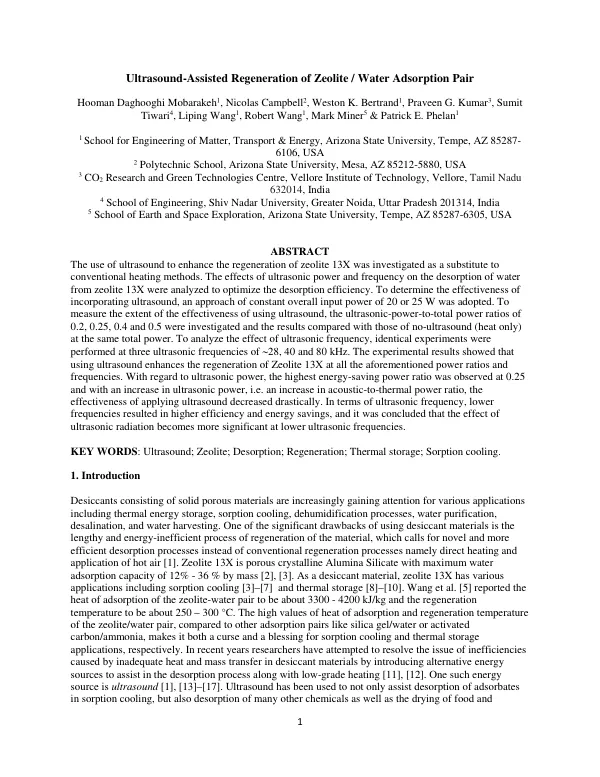
Effects of ultrasound on desorption of water on Zeolite 13X and 4A
The desorption of water from Zeolite 13X and 4A using ultrasound has been studied as a means of enhancing the regeneration of adsorbents for adsorption cooling systems.
2019 · 1 pages
Sign in to readA free account is required to download.
Abstract
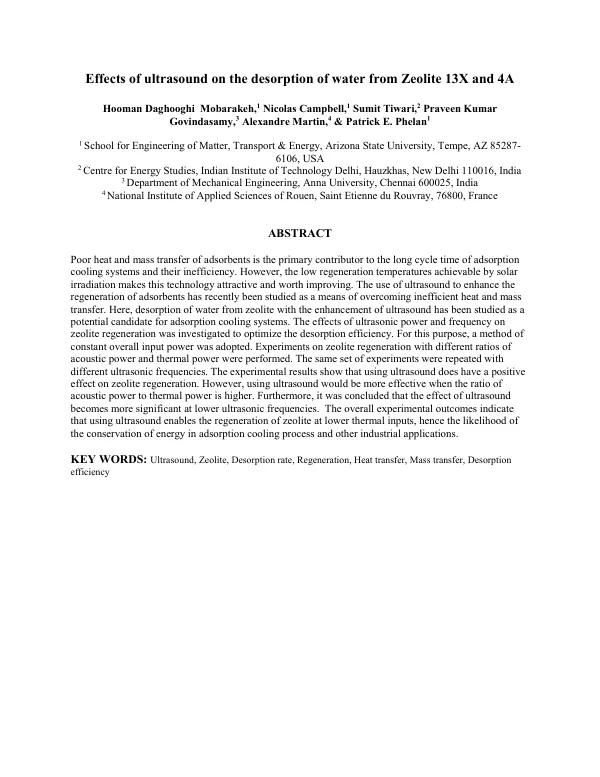
Poor heat and mass transfer of adsorbents is a primary contributor to the long cycle time and inefficiency of these systems. However, the low regeneration temperatures achievable by solar irradiation make this technology attractive and worth improving. The effects of ultrasonic power and frequency on zeolite regeneration were investigated to optimize the desorption efficiency. A method of constant overall input power was adopted, and experiments on zeolite regeneration with different ratios of acoustic power and thermal power were performed. The same set of experiments were repeated with different ultrasonic frequencies. The experimental results show that using ultrasound has a positive effect on zeolite regeneration. The use of ultrasound was found to be more effective when the ratio of acoustic power to thermal power is higher. Furthermore, the effect of ultrasound becomes more significant at lower ultrasonic frequencies. The overall experimental outcomes indicate that using ultrasound enables the regeneration of zeolite at lower thermal inputs, which can lead to the conservation of energy in adsorption cooling processes and other industrial applications. The study focused on the desorption of water from Zeolite 13X and 4A, which are commonly used adsorbents in adsorption cooling systems. The results of the study suggest that the use of ultrasound can enhance the regeneration of these adsorbents, leading to improved efficiency and reduced energy consumption. The findings of this study have implications for the development of more efficient adsorption cooling systems and other industrial applications. The experimental results show that the desorption rate of water from Zeolite 13X and 4A can be significantly improved using ultrasound. The study also investigated the effect of ultrasonic frequency on the desorption efficiency and found that lower frequencies are more effective. The results of this study provide valuable insights into the use of ultrasound for enhancing the regeneration of adsorbents and can contribute to the development of more efficient and sustainable cooling systems.