USAID DEC
Iron detection and remediation with a functionalized porous polymer applied to environmental water samples
Sign inNATIONAL UNIVERSITY OF SCIENCES AND TECHNOLOGY , ISLAMABAD
Iron detection and remediation with a functionalized porous polymer applied to environmental water samples
Iron is one of the most abundant elements in the environment and in the human body.
2019 · 10 pages
Sign in to readA free account is required to download.
Abstract
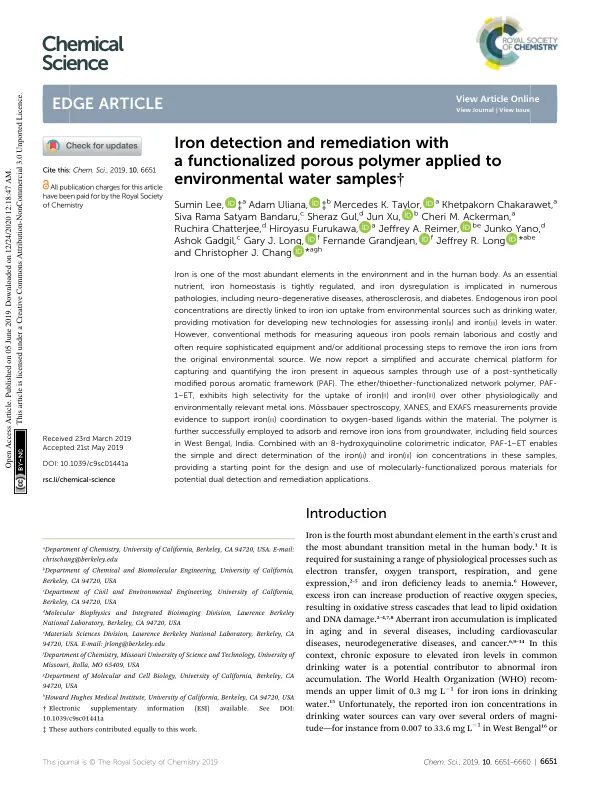
It plays a crucial role in various physiological processes, including electron transfer, oxygen transport, respiration, and gene expression. However, excess iron can lead to oxidative stress and is implicated in several diseases, including cardiovascular diseases, neurodegenerative diseases, and cancer. The World Health Organization recommends an upper limit of 0.3 mg L-1 for iron ions in drinking water. Conventional methods for measuring aqueous iron pools are laborious and costly, often requiring sophisticated equipment and additional processing steps to remove iron ions from the original environmental source. To address this challenge, researchers have developed a simplified and accurate chemical platform for capturing and quantifying iron present in aqueous samples. This platform utilizes a post-synthetically modified porous aromatic framework (PAF) called PAF-1-ET, which exhibits high selectivity for the uptake of iron(II) and iron(III) over other physiologically and environmentally relevant metal ions. PAF-1-ET is a functionalized network polymer that can be employed to adsorb and remove iron ions from groundwater, including field sources in West Bengal, India. When combined with an 8-hydroxyquinoline colorimetric indicator, PAF-1-ET enables the simple and direct determination of iron(II) and iron(III) ion concentrations in these samples. This method has the potential to be used for dual detection and remediation applications. The synthesis of PAF-1-ET involves ether-thioether functionalization of PAF-1, which exhibits highly selective iron(II) and iron(III) ion uptake over competing metal ions in laboratory and field water samples. The combination of this polymer with the 8-hydroxyquinoline indicator enables rapid and quantitative monitoring of iron levels with a simple colorimetric assay. This method has been successfully employed to screen synthetic groundwater and field samples of drinking water collected from West Bengal, India. The researchers used various analytical techniques, including nitrogen adsorption isotherms, infrared spectra, thermal gravimetric analysis, scanning electron microscopy, elemental analyses, UV-Vis spectroscopic measurements, and inductively coupled plasma-mass spectrometry, to characterize the properties and performance of PAF-1-ET. These studies demonstrate the potential utility of this method for remediation and screening of synthetic groundwater as well as field samples of drinking water. This work provides a starting point for the development of new porous polymers for simplified, accurate, and rapid diagnostic and remediation applications without the need for bulky and expensive instrumentation.