INTERNATIONAL ORGANIZATION FOR MIGRATION
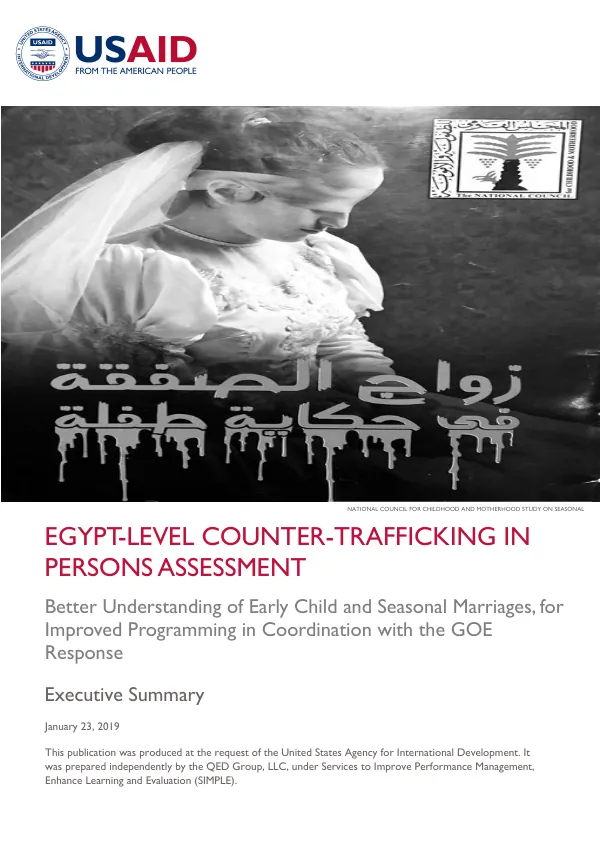
Egypt-Level Counter-Trafficking in Persons Assessment
Egypt-level Counter-Trafficking in Persons Assessment is a comprehensive study aimed at understanding the drivers and scope of trafficking in persons (TIP) issues in Egypt, with a focus on sexually exploitative practices including seasonal marriage and early and child marriage.
2019 · 14 pages
Sign in to readA free account is required to download.
Abstract
The assessment was conducted by the QED Group, LLC, under the Services to Improve Performance Management, Enhance Learning and Evaluation (SIMPLE) contract with the United States Agency for International Development (USAID). The assessment was prompted by the Request for Task Order Proposal (RFTOP) issued by USAID/Egypt on January 29, 2018, which requested an assessment of Egypt-level TIP, with a specific focus on sexually exploitative practices including seasonal marriage and early and child marriage. The purposes of the assessment were to better understand the drivers and scope of TIP issues in Egypt, review and analyze challenges and opportunities involved in developing an effective anti-trafficking response to early and seasonal marriages, describe existing interventions to combat TIP by other donors and the government of Egypt (GOE), and develop actionable recommendations for coordinated U.S. government (USG) engagement in fighting TIP in Egypt. The assessment employed a mixed-methods approach, combining qualitative and secondary quantitative data collection and analysis. Qualitative data were collected through content analysis, while secondary quantitative data were analyzed using Excel sheets and SPSS. The team conducted a comprehensive desk review of existing material in both Arabic and English, undertaking a legal and institutional assessment, reviewing targeted stakeholders to inform field work planning, and unearthing existing statistical data on the phenomenon of trafficking in persons, with a focus on sexual exploitation. The assessment identified several key findings, including the prevalence of early and child marriage in Egypt, the lack of uniformity in the framing of these practices in international policy, and the fragmented and sometimes conflicting legal concepts associated with these practices. The assessment also highlighted the need for a coordinated U.S. government response to combat TIP in Egypt, including the development of new interventions to support existing GOE efforts. The assessment recommended several actions to combat TIP in Egypt, including the development of a nationwide quantitative study to assess the scope and nature of early child and seasonal marriages, the strengthening of existing protection services for victims of TIP, and the improvement of data collection and analysis on TIP. The assessment also emphasized the importance of building partnerships with relevant stakeholders, including the GOE, other donors, and civil society organizations, to combat TIP in Egypt. The assessment's findings and recommendations are intended to inform USAID's programming and policy decisions on TIP in Egypt, as well as to contribute to more informed programming by the Office of Democracy and Governance. The assessment's results may also be of interest to other counter-trafficking in persons stakeholders across the U.S. government, including the U.S. Department of State's Office to Monitor and Combat Trafficking in Persons (TIP Office), the Bureau of International Narcotics and Law Enforcement Affairs (INL), the Bureau of Population, Refugees, and Migration (PRM), and the Bureau of Democracy, Human Rights, and Labor (DRL).
Related documents