DAI GLOBAL, LLC
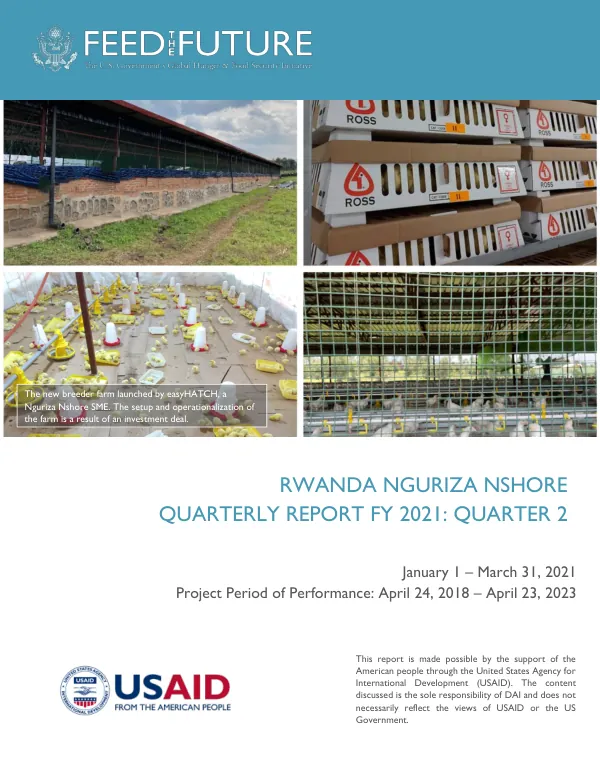
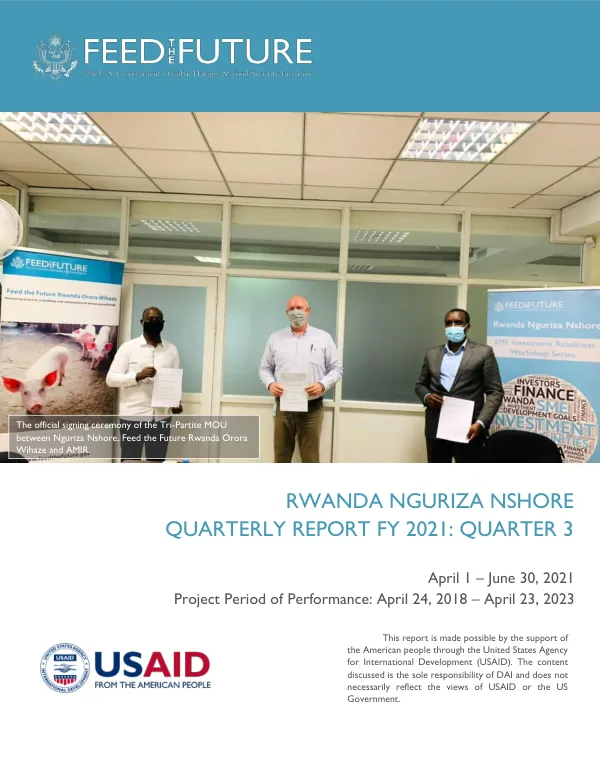
Quarterly Report FY 2021: Quarter 3
Nguriza Nshore is a five-year project implemented by DAI Global LLC, designed by USAID to drive rural economic growth and facilitate the emergence of a dynamic agribusiness sector in Rwanda.
2021 · 59 pages
Sign in to readA free account is required to download.
Abstract
The project aims to expand the capacity of financial institutions to lend to small and medium-sized enterprises (SMEs), increase private and commercial investment in SMEs, and strengthen the enabling environment for SMEs and support firms. The project is centered on three interconnected components: Component I, which improves the capacity of financial institutions (FIs) and non-bank financial institutions (NBFIs) to finance SMEs and agribusinesses; Component 2, which increases private and commercial investment into SMEs and agribusinesses; and Component 3, which strengthens the policy environment for SMEs and agribusinesses to increase their business performance and profitability. Nguriza Nshore works directly with financial institutions, investors, and associations, organizations, and government entities that support them to increase their willingness and capacity to finance agribusiness and SMEs in Rwanda. At the same time, it works directly with these businesses to increase their attractiveness to investors and preparedness to receive and manage investment. By increasing investment in agribusinesses and SMEs, the project creates sustainable employment throughout the market system, which stimulates commercial exchange and ultimately develops the sector as a whole. The COVID-19 pandemic has had a significant impact on the Rwandan economy and population, with national output and gross domestic product (GDP) contracting by 3.4% in 2020. The economic outlook for 2021 is uncertain, with some speculating that further economic turmoil may occur due to containment measures and vaccination efforts. As a result, the project continues to partner with FIs, SMEs, and the Government of Rwanda to explore how best to support economic recovery and new investment. Component I: Improve the capacity of financial institutions (FIs) and non-bank financial institutions (NBFIs) to finance SMEs and agribusinesses. This component focuses on expanding the capacity of FIs and NBFIs to lend to SMEs and agribusinesses, including providing training and technical assistance to improve their lending practices and risk management. Component 2: Increase private and commercial investment into SMEs and agribusinesses. This component aims to increase private and commercial investment into SMEs and agribusinesses by providing investment readiness and advisory services to these businesses, as well as supporting the development of a favorable investment climate. Component 3: Strengthen the policy environment for SMEs and agribusinesses to increase their business performance and profitability. This component focuses on strengthening the policy environment for SMEs and agribusinesses by working with the Government of Rwanda to develop and implement policies that support the growth of these sectors. The project has made significant progress in the third quarter of fiscal year 2021, with notable achievements in all three components. Component I has seen significant growth in the number of SMEs and agribusinesses accessing financing, while Component 2 has seen an increase in private and commercial investment into these sectors. Component 3 has seen significant progress in the development of policies that support the growth of SMEs and agribusinesses. Despite the challenges presented by the COVID-19 pandemic, the project continues to innovate and adapt to the changing circumstances. The project staff has introduced new initiatives, such as the "Investor Series," which aims to provide training and technical assistance to investors and SMEs on how to access financing and investment opportunities. The project also continues to partner with FIs, SMEs, and the Government of Rwanda to explore how best to support economic recovery and new investment.