SAVE THE CHILDREN FUND OF THE UNITED KINGDOM
SUDAN Livelihood Profiles, North Kordofan State
The Household Economy Assessment (HEA) is a livelihood-based framework for analyzing the ways people access the things they need to survive and maintain their livelihood.
2013 · 37 pages
Sign in to readA free account is required to download.
Abstract
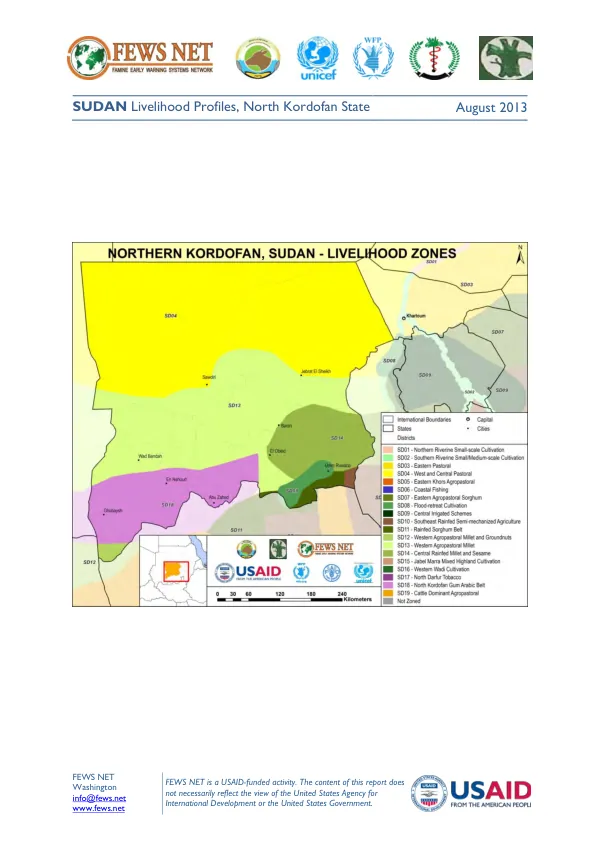
It helps determine people's food and non-food needs and identify appropriate means of assistance, whether short-term emergency assistance or longer-term development programs or policy changes. The HEA defines a livelihood zone as a geographic area in which households obtain their basic survival needs, notably food and cash income, in relatively similar ways. The livelihood profiles presented here explore key characteristics of the socio-economic status and livelihood strategies of three wealth groups (the poor, middle, and better-off) for each livelihood zone within North Kordofan. Detailed, quantitative information about livelihood strategies, food and income sources for each of the three wealth groups is provided. The general characteristics and the primary food, income, and expenditure cycles of poor households are described for each livelihood zone. Finally, the livelihood zones most vulnerable to food insecurity are identified. North Kordofan State is divided into four livelihood zones: the Central Rainfed Millet and Sesame Agropastoral Zone (SD14), the Western Agropastoral Millet Zone (SD13), the North Kordofan Gum Arabic Belt (SD18), and the West and Central Pastoral Zone (SD04). Each zone has distinct characteristics, including different socio-economic groupings, asset bases, consumption patterns, and coping strategies. The livelihood profiles provide a geographic context for establishing monitoring systems and interpreting the relative importance of existing monitoring data on production, prices, and other indicators. The Household Economy Assessment in Sudan has a long history, dating back to the late 1990s when Save the Children Fund (SCF) United Kingdom (UK) in association with the Government of Sudan (GoS) Humanitarian Aid Commission (HAC) used the HEA in North Darfur for drought assessment and estimating food needs. Since then, various organizations, including HAC, the GoS Food Security Technical Secretariat (FSTS), and FEWS NET, have conducted livelihood zoning and profiling in different parts of Sudan. In 2011, FEWS NET organized a national livelihood zoning workshop in Khartoum, which resulted in a livelihood zone map that divided Sudan into 19 zones. Following this workshop, additional livelihood zoning work was conducted in North Kordofan, Red Sea, and Kassala states. Given the demand for high-quality livelihoods-based analysis in Sudan, FEWS NET targeted Sudan as a priority country for updating livelihood reference materials in 2013. A one-day workshop was hosted in Khartoum in December 2012 to assess the perceived usefulness to the Sudanese food security community. Partners recognized the operational importance and usefulness of livelihood profiles and expressed demand for such products. Apart from early warning, a variety of applications were also discussed, including the use of livelihood zones as a sampling frame for anthropometric surveys, for the assessment of Internally Displaced People (IDP) and resettlement, and other developmental applications.