THE WORLD FOOD PROGRAMME
Eligible Uses of Section 202(e) and ITSH Funding
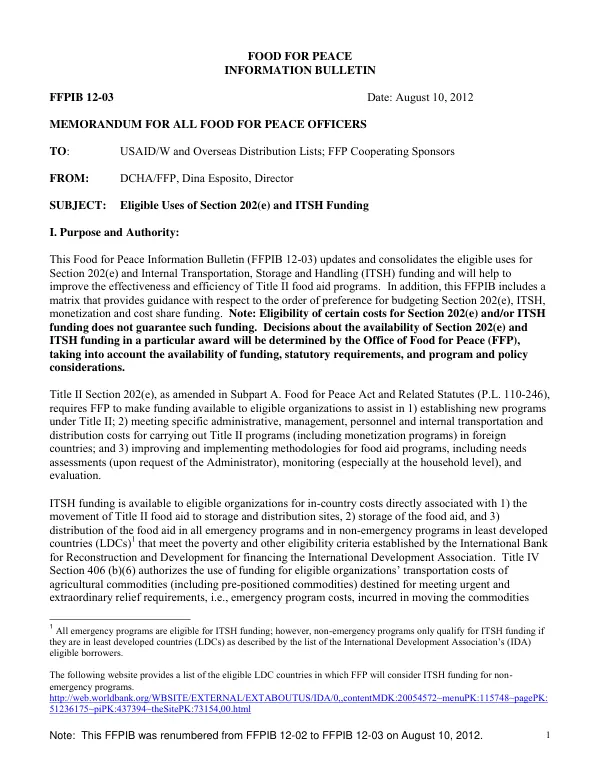
The Food for Peace Information Bulletin (FFPIB) 12-03 updates and consolidates the eligible uses for Section 202(e) and Internal Transportation, Storage and Handling (ITSH) funding.
2012 · 8 pages
Sign in to readA free account is required to download.
Abstract
This bulletin aims to improve the effectiveness and efficiency of Title II food aid programs. Section 202(e) funding is available to eligible organizations to assist in establishing new programs under Title II, meeting specific administrative, management, personnel, and internal transportation and distribution costs for carrying out Title II programs, and improving and implementing methodologies for food aid programs. Eligible organizations for Section 202(e) and ITSH funding include Private Voluntary Organizations (PVOs), Cooperatives, Public Intergovernmental Organizations (PIOs), and foreign governments. Eligible uses for Section 202(e) funding include program materials, tools, and equipment necessary for all program sectors, such as seeds, fertilizers, tools, and equipment, publications related to programming, education, communication, and training materials, building materials used in program activities, and access or provision costs for clean water or a clean water source. Section 202(e) funding may also be used for storage-related costs, such as warehouse leases, fumigation, pesticides, security, property insurance, and A-133 audit costs. Eligible uses for Section 202(e) funding in all programs include specific administrative, management, personnel, and internal transportation and distribution costs for carrying out Title II programs. These costs must be reasonable, allowable, and allocable. ITSH funding is available to eligible organizations for in-country costs directly associated with the movement of Title II food aid to storage and distribution sites, storage of the food aid, and distribution of the food aid in all emergency programs and in non-emergency programs in least developed countries (LDCs). Eligible LDC countries for ITSH funding are listed on the International Development Association's (IDA) website. The Food for Peace Act of 2008 increased Section 202(e) funding from "not less than 5 percent nor more than 10 percent" to "not less than 7.5 percent nor more than 13 percent" and included additional eligible costs. Prior to the 2002 Farm Bill, ITSH funding was only available for emergency programs, but a 2002 Farm Bill amendment expanded the authorized uses of ITSH funding to include costs of non-emergency programs in LDCs. In new programs, eligible uses for Section 202(e) funding must be reasonable, allowable, and allocable, and are subject to the Agreement Officer's determination that the facts of the particular situation support the use of Section 202(e) funding. Costs may include, but are not limited to, those listed below, such as program materials, tools, and equipment, storage-related costs, and administrative, management, personnel, and internal transportation and distribution costs. The bulletin provides a matrix that provides guidance with respect to the order of preference for budgeting Section 202(e), ITSH, monetization, and cost-share funding. Decisions about the availability of Section 202(e) and ITSH funding in a particular award will be determined by the Office of Food for Peace (FFP), taking into account the availability of funding, statutory requirements, and program and policy considerations.
Related documents