USAID
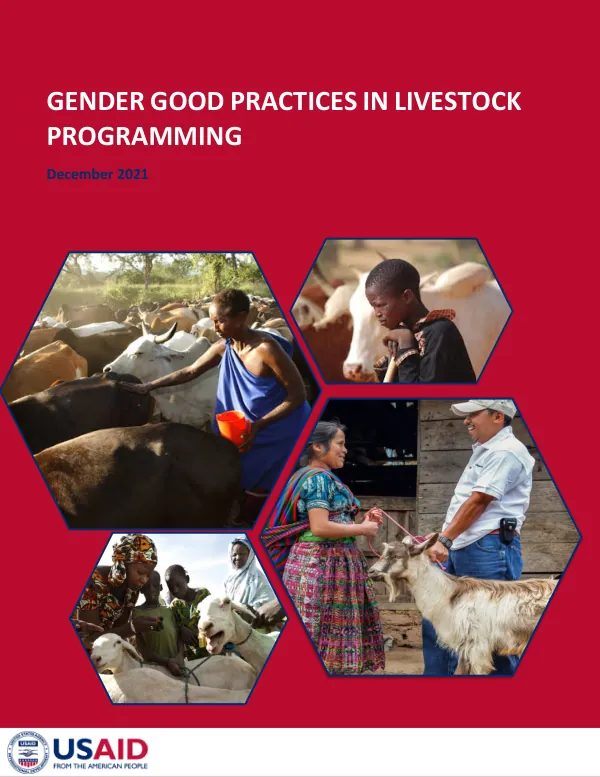
USAID Gender and Livestock Brief
The agricultural sector in developing countries is a significant source of income for millions of people, with women playing a crucial role in livestock production and management.
2021 · 34 pages
Sign in to readA free account is required to download.
Abstract
Women are major contributors to the agricultural economy, but they face various constraints that limit their ability to achieve optimal livestock production and agricultural development. These constraints include limited access to markets, infrastructure, and related services, as well as financial capital and mobility. Women's access to agricultural inputs, services, training, technology, credit, networks, political power, and rights to land, property, and large assets is often constrained in highly patriarchal systems with strongly defined gender roles. Improvements in food security are linked to increases in women's empowerment, with the Food and Agriculture Organization (FAO) estimating that if female farmers had the same access to agricultural services, inputs, technology, and other resources as male farmers, they could increase their crop yields by 20-30%, raise national output by 2.5-4%, and reduce the number of hungry people in the developing world by 100-140 million. The USAID Gender and Livestock Brief is a technical guidance document that supports the implementation of the U.S. Government's Global Food Security Strategy (GFSS). The brief aims to foster an interdisciplinary approach to program design, drawing on the latest evidence and best practices in gender and livestock. The primary purpose of a gender analysis is to analyze the roles of women, men, girls, and boys and identify priority gender issues and programmatic actions that are essential to address for the success of activities or represent important opportunities for female empowerment. A livestock activity-level gender analysis should include information about relevant differences in the status of males and females that could hinder overall activity outcomes, and thus, be addressed through activity design. The gender analysis should be conducted with women, men, girls, and boys in both female-headed and male-headed households, and should also note where characteristics that intersect with gender – such as age, ethnicity, socio-economic status, and location – affect the roles, resources, and benefits of women, men, girls, and boys. The brief outlines steps to conduct a gender analysis and integrate findings into the design of livestock-focused investments. The Appendix contains additional tools, resources, and examples of good practices for gender integration in livestock programming. The brief is designed to provide USAID Agriculture and Food Security program officers, implementing partner staff, extension workers, and gender advisors with practical guidance to strengthen gender equality and female empowerment in their livestock programs. The brief emphasizes the importance of conducting a gender analysis at the start of a design process, but also notes that it can be used at strategic points throughout the program cycle to understand unintended consequences, adjust activities, and assess impact. A gender analysis should identify the aspects of gender relations that are relevant to the programmatic goals and involve the collection and interpretation of a combination of qualitative and quantitative information.