GOVERNMENT OF INDONESIA
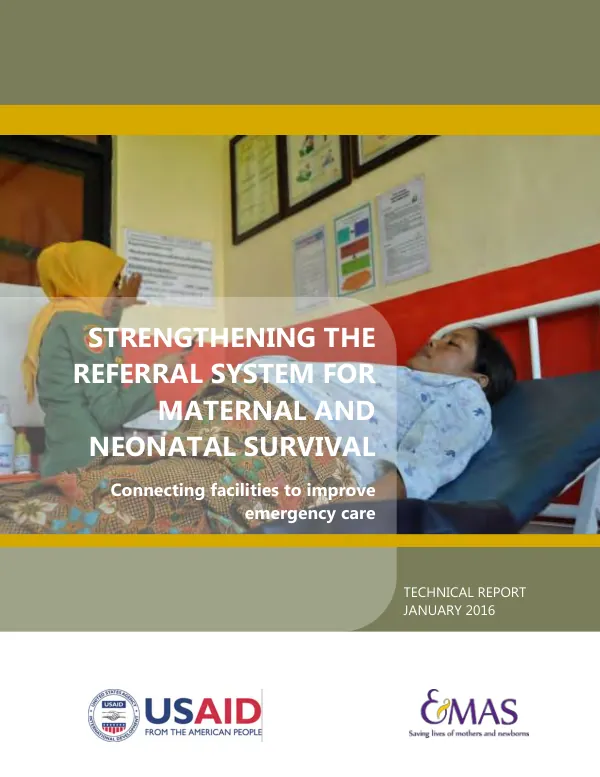
EMAS Year 4 Quarter 1 Report: Expanding Maternal and Neonatal Survival
The USAID/Indonesia Expanding Maternal and Neonatal Survival (EMAS) Project is a five-year program to support the Government of Indonesia in reducing maternal and newborn mortality.
2015 · 50 pages
Sign in to readA free account is required to download.
Abstract
The project focuses on two major objectives: improving the quality of emergency obstetric and neonatal care services in hospitals and community health centers, and increasing the efficiency and effectiveness of referral systems between community health centers and hospitals. During Year 4, Quarter 1, EMAS continued to support mentoring across Phase 2 districts and facilities. Mentors are maturing in their new mentoring roles, and Provincial rosters of mentors were developed. In-depth reviews of maternal deaths were initiated together with POGI and facility staff to better understand the contextual factors contributing to maternal deaths in EMAS-supported facilities. Data collection for the EMAS program evaluation was initiated in Phase Three districts, and preparation for expansion into seven new Phase 3 districts began. A significant MOU was facilitated amongst numerous faith-based organizations to formalize a strong inter-faith commitment to saving lives of mothers and newborns. A total of 37,762 live births were recorded across EMAS Phase 1 and Phase 2 facilities, an increase of more than 3,000 live births compared to the previous quarter. The number of maternal and newborn deaths across all EMAS facilities was 118 and 1,001, respectively. Among all facilities, postpartum hemorrhage (PPH) and severe pre-eclampsia/eclampsia (PE/E) continue to be the most common complications associated with maternal mortality. Birth asphyxia and complications from being born with low birth weight continue to be the most common complications reported as associated with newborn deaths. Coverage against all maternal and newborn evidence-based practices in both Phase 1 and Phase 2 facilities has continued to show progress, except for the provision of MgSO4 for severe PE/E cases in Phase 2 facilities. While data shows improvements in the provision of MgSO4 before referral among all facilities, this indicator still remains much lower than desired. Phase 2 includes 13 hospitals that receive clinical support but do not receive referral system strengthening support. The EMAS project is working with at least 150 hospitals and 300 community health centers across 30 districts and cities in six provinces. The project aims to contribute to an overall 25% decline in national maternal and newborn mortality. EMAS will also emphasize scale-up and sustainability to impact districts and provinces outside of the EMAS target districts. In Phase 1, the number of women delivering increased from 10,244 in Year 3 to 12,893 in Year 4, Quarter 1. The number of live births also increased from 12,791 in Year 3 to 12,744 in Year 4, Quarter 1. In Phase 2, the number of women delivering increased from 22,209 in Year 3 to 25,547 in Year 4, Quarter 1. The number of live births also increased from 22,008 in Year 3 to 25,300 in Year 4, Quarter 1. The EMAS project is making progress in improving the quality of emergency obstetric and neonatal care services and increasing the efficiency and effectiveness of referral systems between community health centers and hospitals. However, there are still challenges to be addressed, particularly in the provision of MgSO4 for severe PE/E cases in Phase 2 facilities.