CONSERVATION INTERNATIONAL FOUNDATION
USAID SEA Monthly Update Vol.8, September 2019
The USAID Sustainable Ecosystems Advanced (USAID SEA) Project is a five-year initiative that supports the Government of Indonesia to improve the governance of fisheries and marine resources and to conserve biological diversity at local, district, provincial, and national levels.
2019 · 4 pages
Sign in to readA free account is required to download.
Abstract
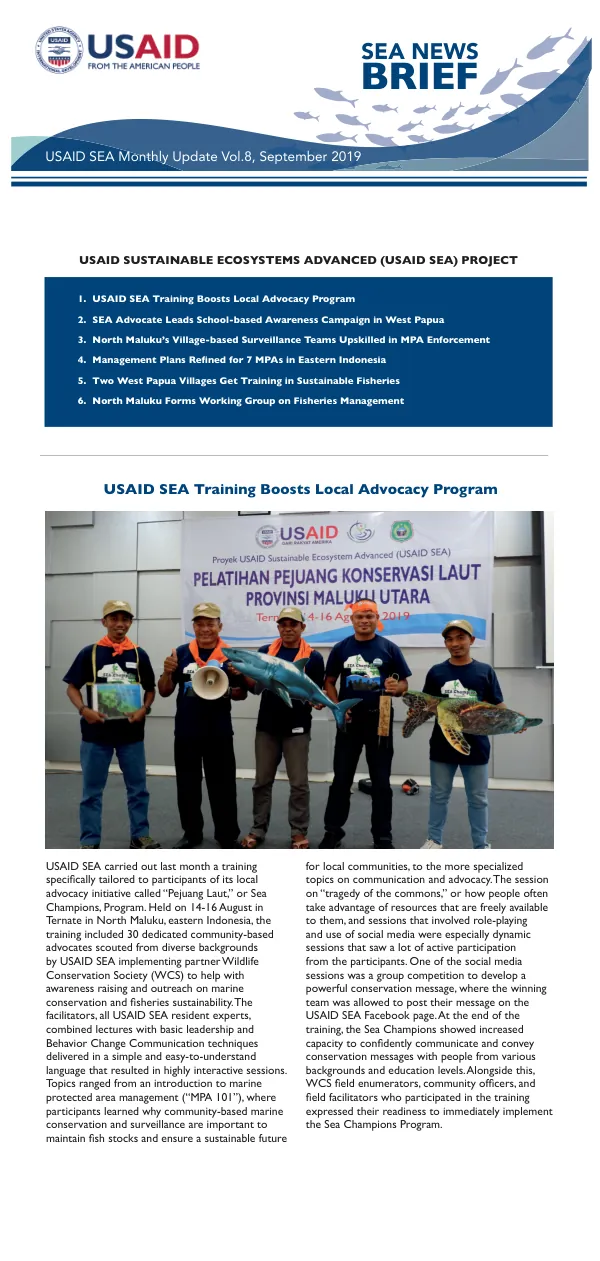
The project is implemented through a consortium of partners and runs from March 2016 through March 2021. In August 2019, USAID SEA carried out a training specifically tailored to participants of its local advocacy initiative called "Pejuang Laut," or Sea Champions, Program. The training was held in Ternate, North Maluku, and included 30 dedicated community-based advocates from diverse backgrounds. The facilitators, all USAID SEA resident experts, combined lectures with basic leadership and Behavior Change Communication techniques delivered in a simple and easy-to-understand language. Topics ranged from an introduction to marine protected area management to communication and advocacy. The training resulted in highly interactive sessions, with participants showing increased capacity to confidently communicate and convey conservation messages with people from various backgrounds and education levels. Alongside this, WCS field enumerators, community officers, and field facilitators who participated in the training expressed their readiness to immediately implement the Sea Champions Program. In West Papua, Fitriyanti Killian, a trained Sea Champion, led an educational and outreach activity on ecosystem and marine protection organized by Conservation International with the West Papua Provincial Marine and Fisheries Office. The activity was attended by 46 enthusiastic students from the Islamic Elementary School in Fakfak, and Fitri used interactive teaching techniques to facilitate understanding of marine conservation concepts in a non-threatening setting. Community-based marine and fisheries groups called POKMASWAS in four villages in Indonesia's North Maluku Province now include among their ranks members who have been trained in marine and fisheries monitoring and data collection for the purpose of enforcing marine protected areas (MPAs). Twenty POKMASWAS members from the North Maluku villages of Waitamela, Fatkauyon, Waisum, and Waisakai participated in a training conducted by the Coral Triangle Center, a USAID SEA implementing partner. The management plans for seven marine protected areas (MPAs) in three provinces in eastern Indonesia have been refined to include all required information based on the standard format prescribed by Decree No. 30/2010 of the Ministry of Marine Affairs and Fisheries (MMAF). This came as a result of a coaching clinic conducted by USAID SEA in collaboration with the MMAF, U.S. National Oceanic and Atmospheric Administration, and U.S. Department of the Interior. In West Papua, two villages, Manimeri and Bintuni, received training in sustainable fisheries. The training was conducted by World Wildlife Fund, a USAID SEA implementing partner, and had 26 participants from relevant government institutions, Bintuni Bay Marine Protected Area initiation team, industrial-scale fisheries sector, and other local and non-local organizations engaged in marine and coastal resource use and management in the Bintuni Bay area. The Provincial Marine and Fisheries Services of North Maluku has established a Working Group on Fisheries Management to engage stakeholders in the process of fisheries management. USAID SEA, through its partner Wildlife Conservation Society, supported this effort by facilitating the working group's meeting on 9-11 September. The meeting reviewed the status of reef fish stocks and fisheries and drafted operational measures of fisheries management.