USAID DEC
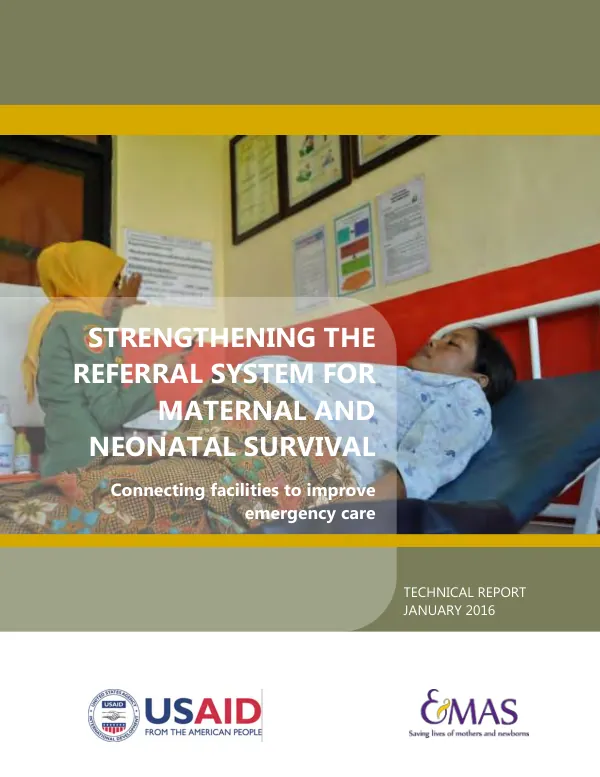
Strengthening the Referral System for Maternal and Neonatal Survival: Connecting Facilities to Improve Emergency Care
Sign inGOVERNMENT OF INDONESIA
Strengthening the Referral System for Maternal and Neonatal Survival: Connecting Facilities to Improve Emergency Care
The Expanding Maternal and Neonatal Survival (EMAS) program in Indonesia aims to accelerate reductions in maternal and newborn mortality by improving the quality of care within health facilities and strengthening the referral system between health centers and hospitals.
2016 · 38 pages
Sign in to readA free account is required to download.
Abstract
The program focuses on addressing the "three delays" in seeking, reaching, and receiving care when an obstetric or neonatal emergency occurs. EMAS implements a set of inter-related interventions to increase the efficiency and effectiveness of the referral system. These interventions include referral performance standards and tools to assess, monitor, and improve referrals. The referral standard tools provide District Health Offices (DHOs) and facilities with a standardized mechanism to quantitatively assess their referral system, identify gaps, and measure progress. These tools are implemented by DHO Facilitative Supervision teams across EMAS-supported districts on a quarterly basis. Another key intervention is the referral network MOU (Perjanjian Kerjasama, or PKs) to strengthen linkages and formalize referral networks between puskesmas and hospitals. PKs provide the basis to strengthen the referral network by defining its governance, ensuring that all actors within a referral network have clearly defined and agreed roles and responsibilities. PKs are currently in place across 28/30 EMAS-supported districts. An automated referral exchange system, SijariEMAS, is also used to improve communication and coordination of emergency referrals between midwives, puskesmas, and referral hospitals. SijariEMAS is introduced to a district after the PK has been developed. As of September 2015, the system is in use in 29/30 EMAS-supported districts. Where SijariEMAS has strong DHO support, such as in West Java, it is being used for the majority of emergency referrals made each month. Maternal and perinatal death audits (MPA) at the district level are also conducted to identify weaknesses or barriers in the health/referral system that may have contributed to maternal and perinatal deaths. EMAS has worked at a number of levels to support the routine implementation of the 2010 MPA National Guidelines, and to improve the quality of audits. While there has been progress, the level of support varies between districts, and despite EMAS efforts, the frequency and quality of MPAs is less than ideal. In addition, maternal and child health motivators (MKIA) are used to help reduce financial barriers to emergency health care through promoting the uptake of social health insurance. EMAS uses volunteer MKIAs to address specific issues related to maternal and newborn survival at the village level, such as identification and monitoring of high-risk cases, promoting facility-based delivery, and use of universal health insurance (JKN). Overall results indicate steady progress for all referral interventions across EMAS-supported districts. Communication and coordination have improved, as evidenced by signed referral network PKs and use of SijariEMAS. The number and proportion of referrals managed by SijariEMAS have significantly increased over the course of EMAS, although there is wide variation between districts. The proportion of referrals responded to in a timely manner (within ten minutes) has hovered around 75%, although the total numbers involved have increased. Aggregated referral performance standard results indicate that overall the referral system is becoming more efficient. By the end of EMAS Year 4 (September 2015), 90% of Phase 1 and 87% of Phase 2 districts were achieving over 80% of referral standards. While MPAs are not yet "routine," the proportion of maternal deaths reviewed has steadily increased to 52% in Phase 1, and 48% in Phase 2 districts. There has been less progress in terms of neonatal death audits, with only 16% and 21% of deaths reviewed for Phase 1 and 2 districts respectively. Coverage of key interventions can be used to indicate improved effectiveness of the referral system. While there has been progress in key interventions such as MgSO4 for PE/E and antibiotics for suspected neonatal sepsis, this has been slower than hoped. However, if EMAS-supported facilities are compared to facilities not involved in the program/EMAS, the former have significantly higher rates of providing these life-saving interventions. A number of lessons are evident to date. All initiatives need to work together to have the greatest effect on strengthening emergency referrals between facilities. The more facilities involved with interventions such as PKs, the better, and linking to EMAS accountability mechanisms—Pokja and Civic Forum—is also critical. Utilizing GoI policies, structures, and funding has helped to promote sustainability of interventions.