USAID DEC
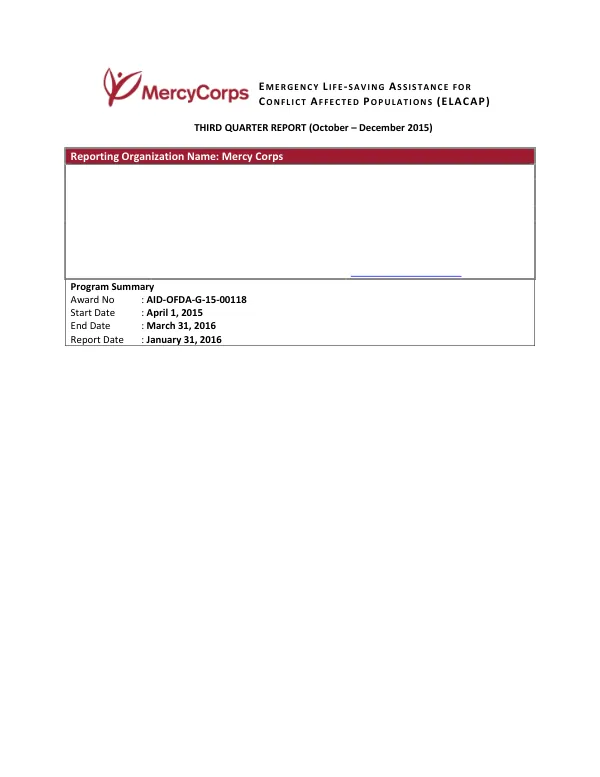
Emergency Life Saving Assistance for Conflict Affected Populations (ELACAP) Q3 Report (October 2015 – December 2015)
Sign inIOM
Emergency Life Saving Assistance for Conflict Affected Populations (ELACAP) Q3 Report (October 2015 – December 2015)
The Emergency Life Saving Assistance for Conflict Affected Populations (ELACAP) program in South Sudan began in April 2015 with funding from USAID's Office of Foreign Disaster Assistance (OFDA).
2015 · 9 pages
Sign in to readA free account is required to download.
Abstract
The program aimed to provide emergency assistance to conflict-affected populations in the Abyei Administrative Area (AAA) and Bentiu Protection of Civilian (PoC) site. The program's primary focus was on water, sanitation, and hygiene (WASH) services, as well as economic recovery and market systems. During the third quarter reporting period (October to December 2015), the program continued to face challenges due to the ongoing conflict in South Sudan. The formation of 28 states deepened the divide between ethnicities, and the Bentiu PoC site remained the largest displacement site in the country, with a population of 106,000. Food insecurity increased due to the depreciation of the South Sudanese Pound and limited access to hard currency, leading to an increase in staple food prices. Mercy Corps, the implementing partner, decided to close the Agok compound and shift the remaining ELACAP funds to the Mercy Corps Bentiu office to respond to the influx of internally displaced persons (IDPs) in the PoC. The team provided termination notices and terminal benefits to staff in Agok and supported the remaining team in closing out activities and building capacity on data entry and database creation and analysis. The WASH sector continued to be a priority, with a focus on providing emergency water and sanitation services to 8,000 conflict-affected people in the Bentiu PoC site. The team treated and distributed 137,000 liters of water daily to a population of approximately 12,318 people, with a goal of reaching the Sphere standards of 15 liters per person per day. However, due to low rains and increased population, the team was unable to meet this target. In the sanitation infrastructure sector, the IOM site development team was unable to continue developing the area due to wet soil conditions, resulting in no construction from October to mid-December. However, part of block 4 was developed, and 33 stances of latrines were constructed. A cumulative 303 semi-permanent latrines had been constructed to date. The hygiene promotion sector focused on constructing and maintaining communal hand-washing facilities, communal bathing spaces, and communal laundry spaces. Mercy Corps installed 52 hand-washing stands in the seven finalized blocks within Sector 1.2, and negotiations were finalized with the Site Development team from IOM to construct laundry spaces, which commenced in early February. The economic recovery and market systems sector focused on providing temporary employment and microfinance services to conflict-affected populations. Mercy Corps provided training and support to national staff, recognizing the importance of building capacity for national staff development. The humanitarian coordination and information sharing sector focused on providing information and coordination support to humanitarian partners in the region. Mercy Corps worked closely with the WASH Cluster and other humanitarian partners to ensure effective coordination and response to the needs of conflict-affected populations. Overall, the ELACAP program continued to face challenges in the third quarter reporting period, but the team remained committed to providing emergency assistance to conflict-affected populations in South Sudan.
Related documents