CHEMONICS INTERNATIONAL, INC.
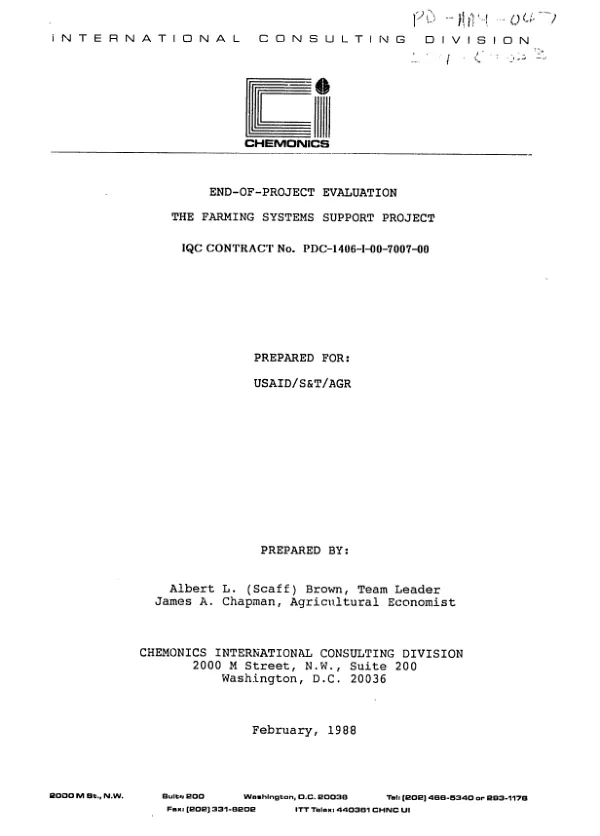
End-of-project evaluation : the farming systems support project
Final evaluation of a project to provide farming systems research and extension (FSR/E) TA, training, and information dissemination and to strengthen the capabilities of the University of Florida (UF) and other support entities (SE"s) to do this.
Brown, Albert L.; Chapman, James A. · 1988
Sign in to readA free account is required to download.
Abstract
Evaluation focuses on the period since the mid-term evaluation (6/85-12/87). The project was much more successful in certain areas than in others, but achievements overall were constrained by a lack of consensus - both within A.I.D., and among A.I.D., UF, and the other SE"s - as to what the project"s objectives and strategy should be. This lack was recognized by the mid-term evaluation, but was not sufficiently overcome, and as a result A.I.D. decided to reduce funding and to terminate the project at the end of 1987. Nonetheless, the project did produce a number of useful products, including several training courses and workshops in the U.S. and abroad on various topics. The courses, while initially weak, improved substantially as the trainers gained experience and better materials were developed. Also, a limited amount of TA was provided to Missions in project design and evaluation; although the TA was generally well-received, demand was far lower than expected. Networking was probably the most successful activity. The project established an SE network with 21 U.S. universities and 4 consulting firms (most, however, felt underutilized and were to drop out eventually). It also supported two networks in West Africa (following the mid-term evaluation, West Africa became the project"s explicit geographic focus). Finally, a number of publications were developed, including a newsletter with a circulation of 5,000, two internal network newsletters, a series of technical papers on field experiences and advances in methodology, and a series of annotated bibliographies. The project also developed an on-going documentation center within S&T and a statistical package for use in on-farm experiments. Lessons learned flow directly from the project"s principal problem - that work in a poorly defined subject area, as FSR/E was and still is, is inherently difficult and risky, making a well-designed project and well-defined management and decisionmaking responsibilities absolutely essential. Relationships between A.I.D. and UF - which held directly conflicting views of their roles - were adversarial almost from the start. Greater care should have gone into project design and into selection of a contractor.