USAID DEC
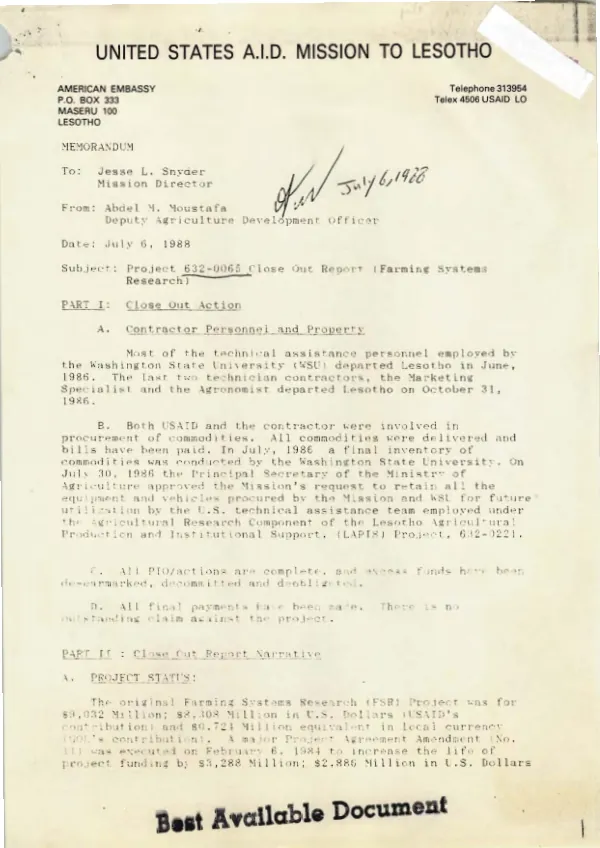
Memorandum to Jesse L. Snyder on project 632-0065 close out report (farming systems research)
Sign inUSAID. MISSION TO LESOTHO
Memorandum to Jesse L. Snyder on project 632-0065 close out report (farming systems research)
Presents final Mission report on a 1979-86 project to institutionalize a farming systems research (FSR) component within the Research Division (RD) of the Lesotho Ministry of Agriculture (MOA).
Moustafa, Abdel M. · 1988
Sign in to readA free account is required to download.
Abstract
The project achieved most of its goals, though some, like establishing an FSR section in the RD, were replaced by other approaches to overall objectives. Achievements were as follows. (1) The project improved the understanding of deficiencies in traditional production practices and of how cultural and economic factors influence the acceptance of new technologies. The goal of adoption of a new technology by 5% of prototype area farmers was surpassed, with farmers showing a willingness to put their own money into new technology. (2) Research results were disseminated through a publication series (bulletins, reports, and circulars). Handboooks are revised and disseminated as needed. (3) There is now continual interaction with international centers such as CIMMYT and ICRISAT and cooperation in a sorghum and maize testing program with these centers. (4) The project generated an understanding of the limitations and characteristics of each of the major ecological zones in the country from work in three prototype areas. (5) Information was transferred to farmers through radio broadcasts, counterpart training, and demonstration field days. An in-depth analysis of the results indicates a marked impact on the knowledge, attitudes, skills, and aspirations of farmers involved with a sustained extension program. (6) The project surpassed its target of 16 long-term degree trainees and also conducted continuous short-term training. (7) The Agricultural Research Library was developed into a well-organized repository serving the needs of many agencies in Lesotho. On the other hand, progress was slower than desirable in increasing support and recognition for the RD from the MOA administrators and other Divisions, and in establishing a solid research capability in the RD. There is a shortage of research leaders who can design and implement successful programs in the various disciplines. Capable support personnel are not available, and the attitude and dedication which are ubiquitous in the best research units has not yet fully developed. However, these essential qualities should develop with the provision of the proper administrative guidance and the necessary technical resources. Three lessons were learned. (1) Institution building is a long-term process requiring substantially more than the usual 5-year project. (2) Researchers should receive not only technical support, but also training in research policy, planning, and management. (3) To ensure the exposure of MOA participants to a diverse range of disciplines and approaches, long-term training should not be centered at one institution.