USAID DEC
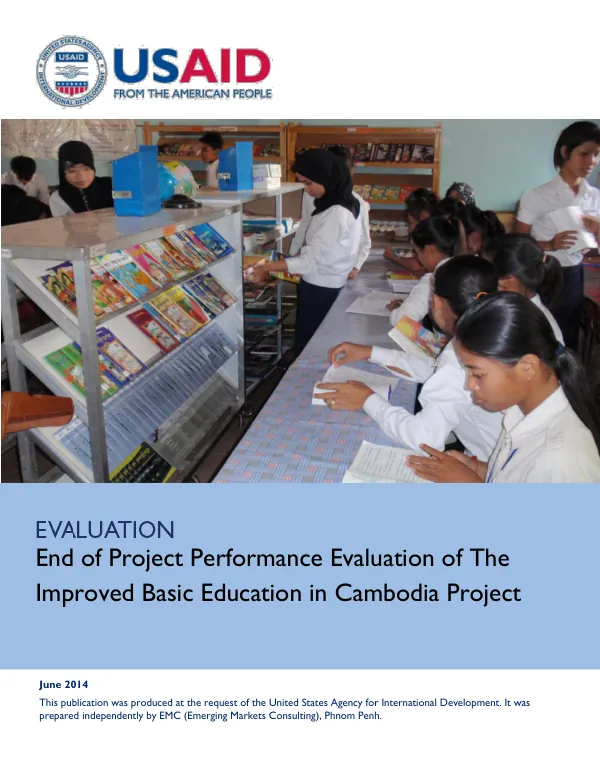
End of Project Performance Evaluation of The Improved Basic Education in Cambodia Project
Sign inEMERGING MARKETS CONSULTING
End of Project Performance Evaluation of The Improved Basic Education in Cambodia Project
The Improved Basic Education in Cambodia Project was a USAID-funded initiative aimed at promoting better-educated youth in Cambodia with increased access to quality and relevant basic education.
2014 · 102 pages
Sign in to readA free account is required to download.
Abstract
The project was implemented in three target provinces: Kampong Cham, Kratie, and Siem Reap. The project's primary objective was to improve the quality of basic education in these provinces, with a focus on increasing secondary enrollment, reducing dropout rates, and promoting gender parity. The project's implementation period spanned from 2009 to 2014, with a total budget of $15 million. The project's interventions included the establishment of Child-Friendly Schools, the provision of teacher training, and the promotion of life skills activities. The project also focused on improving the quality of education through the introduction of new curricula and teaching methods. The project's evaluation was conducted by EMC (Emerging Markets Consulting) in June 2014. The evaluation aimed to assess the project's performance and identify lessons learned and best practices. The evaluation used a mixed-methods approach, combining both quantitative and qualitative data collection methods. The evaluation team collected data from various sources, including project documents, interviews with stakeholders, and surveys of students, teachers, and community members. The evaluation found that the project had made significant progress in improving secondary enrollment rates in the target provinces. The data showed that secondary enrollment rates increased by 15% in Kampong Cham, 12% in Kratie, and 10% in Siem Reap. The project also reported a reduction in dropout rates, with a decrease of 10% in Kampong Cham, 8% in Kratie, and 6% in Siem Reap. The evaluation also found that the project had made significant progress in promoting gender parity in education. The data showed that the gender parity index (GPI) increased by 10% in Kampong Cham, 8% in Kratie, and 6% in Siem Reap. The project also reported an increase in the number of girls enrolled in secondary school, with a total of 1,500 girls enrolled in the target provinces. The evaluation identified several best practices and lessons learned from the project. One of the key findings was the importance of community engagement and participation in the project's implementation. The evaluation team found that community members played a crucial role in promoting the project's interventions and ensuring their sustainability. The evaluation also highlighted the importance of teacher training and capacity building in improving the quality of education. The evaluation made several recommendations for future projects, including the need for more targeted interventions to address the needs of disadvantaged groups, such as girls and children from poor families. The evaluation also recommended the need for more effective monitoring and evaluation systems to track project progress and identify areas for improvement.