USAID DEC
Impact Evaluation of USAID/Cambodia Countering Trafficking in Persons (CTIP) Program
Sign inNORC AT THE UNIVERSITY OF CHICAGO
Impact Evaluation of USAID/Cambodia Countering Trafficking in Persons (CTIP) Program
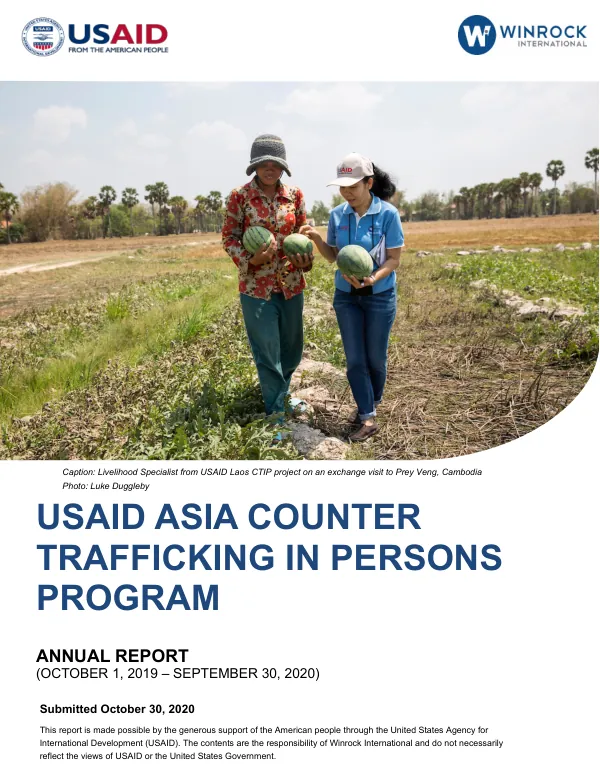
The USAID/Cambodia Countering Trafficking in Persons (CTIP) Program aimed to disrupt trafficking in persons (TIP) patterns by offering diversified, climate-resilient livelihood pathways that reduce dependence on seasonal agriculture and educating vulnerable individuals on unsafe migration.
2020 · 2 pages
Sign in to readA free account is required to download.
Abstract
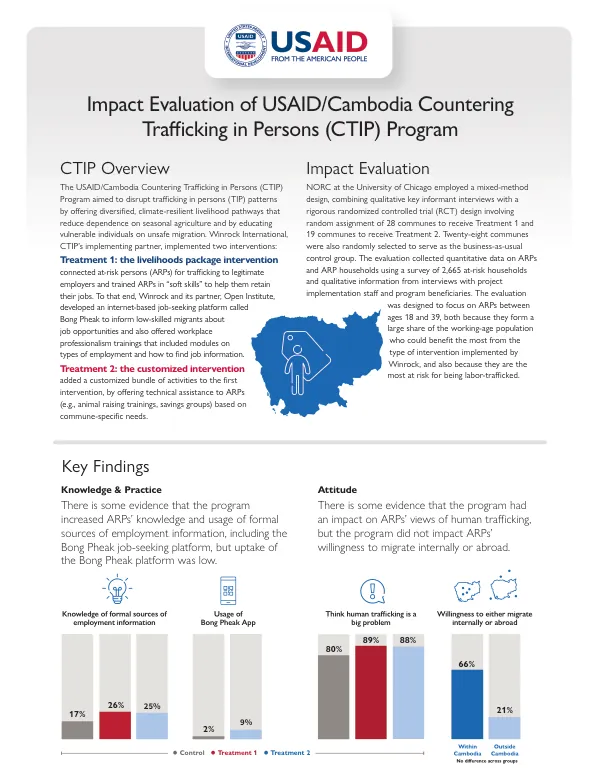
Winrock, the program's implementer, implemented two interventions: Treatment 1, which connected at-risk persons (ARPs) to legitimate employment and trained them in soft skills to retain their jobs, and Treatment 2, which offered a customized bundle of activities, including technical assistance to ARPs based on commune-specific needs. The evaluation, conducted by NORC at the University of Chicago, employed a mixed-method design, combining qualitative interviews with a rigorous randomized controlled trial (RCT) design. The evaluation collected quantitative data from 2,665 at-risk households and qualitative information from project implementation staff and beneficiaries. The evaluation focused on ARPs between ages 18 and 39, who are at a higher risk of being trafficked. The evaluation found some evidence that the program increased ARPs' knowledge and usage of formal sources of employment, including the Bong Pheak job-seeking platform. However, uptake of the Bong Pheak platform was low. The program also had an impact on ARPs' views of human trafficking, but it did not affect their willingness to migrate internally or abroad. The evaluation collected data on ARPs' knowledge of formal sources of employment, usage of the Bong Pheak app, and views on human trafficking. The evaluation found that 17% of ARPs used the Bong Pheak app, while 9% of ARPs thought human trafficking is a big problem within Cambodia and 26% thought it is a big problem outside Cambodia. The evaluation also found that there was no difference in ARPs' willingness to migrate internally or abroad between the treatment and control groups. The evaluation made several recommendations for future USAID CTIP programming and evaluation. The first recommendation is to carefully identify labor trafficking determinants in each country and design culturally competent and context-appropriate interventions to prevent trafficking. The second recommendation is to work with local community organizations to identify at-risk young men who have migrated and design interventions to prevent them from migrating unsafely. The evaluation also recommended targeting women with prevention programs to raise awareness among women and affect intra-household norms over time. The evaluation found that different training modalities, including interactive pedagogy, impacted how well messages were received. The evaluation also recommended utilizing training modalities that are tailored to local contexts and coordinating and aligning the goals of different stakeholders to achieve a common learning agenda. The evaluation found that Treatment 2 led to a statistically significant impact on ARPs' savings group membership. The program had difficulty identifying young, male ARPs, who were the focus of the evaluation. The average age of ARPs across both treatment groups was 31 years old, and nearly three-quarters of ARPs were female. The evaluation found that the savings group activity was the most attended and most attended program activity.