USAID DEC
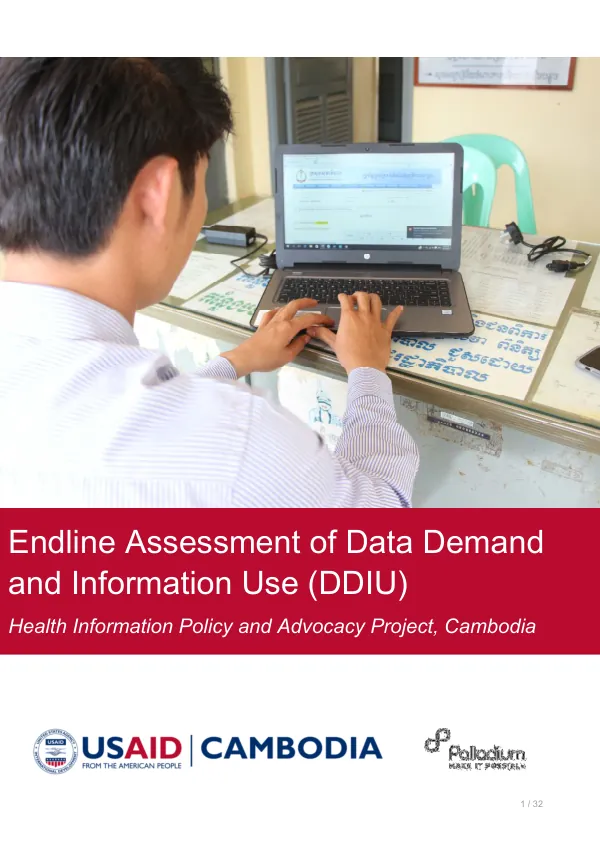
Endline Assessment of Data Demand and Information Use (DDIU) Health Information Policy and Advocacy Project, Cambodia
Sign inMINISTRY OF HEALTH
Endline Assessment of Data Demand and Information Use (DDIU) Health Information Policy and Advocacy Project, Cambodia
The Health Information Policy and Advocacy Project (HIPA) in Cambodia aimed to improve data demand and information use in the health sector.
2019 · 32 pages
Sign in to readA free account is required to download.
Abstract
The project was supported by the United States Agency for International Development (USAID) and involved collaboration with the Department of Planning and Health Information (DPHI) of the Ministry of Health (MoH) and Provincial Department of Health (PHD) in three provinces: Banteay Meanchey, Prey Veng, and Pailin. The project's data use logic model, as depicted in Figure 1, highlights the importance of data access, data use, and data quality in informing decision-making. The model emphasizes the need for a robust health management information system (HMIS) to support data-driven decision-making. The endline assessment of data demand and information use (DDIU) was conducted to evaluate the project's impact on data use and decision-making. The assessment involved a rapid quantitative survey of 1,200 respondents from health facilities and commune councils, as well as in-depth key informant interviews with 30 stakeholders. The survey and interviews were conducted in the three project provinces. The assessment found that the use of health data in decision-making had increased significantly since the baseline assessment. Figure 2 shows that 71% of health facility staff reported using HMIS data in the past 12 months, compared to 45% at baseline. The use of health data for community investment plan (CIP) preparation also increased, with 85% of commune council respondents reporting that they always use health data for CIP preparation, compared to 55% at baseline (Figure 3). The assessment also found that the HMIS met the data needs of health facility staff to a moderate extent, with 60% of respondents reporting that the HMIS met their data needs (Figure 6). However, the HMIS faced challenges in terms of data quality, with 40% of respondents reporting that the HMIS data was not accurate or complete. The assessment made several recommendations to strengthen the organization's data demand and use (DDU) infrastructure and culture. These recommendations included building capacity in data use core competencies, strengthening the DDU infrastructure, and improving data quality. The assessment also recommended that the HMIS be used to support decision-making at all levels of the health system. The project's findings and recommendations have implications for the development of health information systems in Cambodia and other low- and middle-income countries. The assessment highlights the importance of a robust HMIS in supporting data-driven decision-making and the need for ongoing capacity building and infrastructure development to ensure the effective use of health data.