USAID DEC
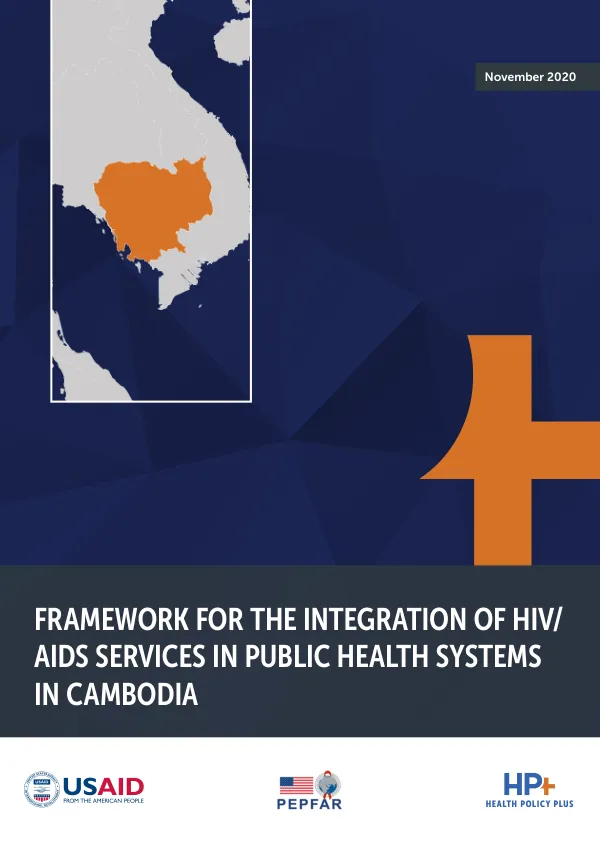
Expanding Health Equity Fund Coverage for People Living with HIV in Cambodia: Costing and Policy Options
Sign inAVENIR HEALTH
Expanding Health Equity Fund Coverage for People Living with HIV in Cambodia: Costing and Policy Options
Cambodia faces challenges in sustaining its impressive progress in the HIV response as donor funding declines and the need to rely on domestic resources increases.
2020 · 30 pages
Sign in to readA free account is required to download.
Abstract
The Health Equity Fund (HEF) is a demand-side financing scheme in Cambodia targeted to the bottom quintile of the population. Fund beneficiaries receive healthcare services free of charge, while providers receive top-up payments according to a set reimbursement schedule for the provision of services to beneficiaries. In July 2019, new HEF service packages were implemented, including an HIV service package. The Royal Government of Cambodia has increased its financial contribution to the pooled financing mechanism for the HEF, resulting in an increase in domestic government expenditure on HIV services. However, this increase is only for people living with HIV who carry ID Poor cards and are covered by the HEF. It is estimated that over half of the population of people living with HIV who are poor do not have an ID Poor card. The National AIDS Authority requested the Health Policy Plus project to undertake an analysis to estimate the cost implications of expanding HEF coverage to more people living with HIV. Three coverage scenarios were considered: baseline coverage reflecting the current situation, HEF coverage for people living with HIV who should have an ID Poor card, and HEF coverage for all people living with HIV. If all poor people living with HIV receive an ID Poor card to access the HEF, the resources required is estimated at USD 814,000 per year, an increase of USD 428,000 per year from the baseline. If all people living with HIV are covered under the HEF, the resources required increases to USD 2.1 million per year. The priority of Cambodia's HIV program is to achieve the 95-95-95 targets by 2025 and to sustain that response over the long term. The country's current success with its HIV response is driven by strong political will, a consistent and consolidated national strategic framework, firm partnerships and funding commitments, and contributions from various stakeholders. According to the World Bank, Cambodia graduated to lower-middle-income country status in 2015, precipitating declines in external financial assistance, which are expected to continue in coming years. Challenges identified through the HIV transition readiness assessment include mitigating the substantial decline of donor funding and increasing domestic resource mobilization for health. The analysis has informed policymakers, including the Policy Board of the National AIDS Authority, and has been used for advocacy with the Ministry of Health, the Ministry of Economics and Finance, and the Ministry of Planning. The evidence generated through this analysis will continue to contribute to the implementation of expanding HEF coverage for all people living with HIV. The Royal Government of Cambodia has ratified a policy circular, SarChorNor #213, which recognizes all people living with HIV as a vulnerable population eligible for the equity cards for the HEF.
Related documents