USAID. MISSION TO PAKISTAN
Energy planning and development (EP&D)
Summarizes attached midterm evaluation (XD-AAY-867-A) of a project to strengthen the energy analysis and planning capabilities of the Government of Pakistan (GOP); establish a national energy conservation program; and develop indigenous energy resources.
1989
Sign in to readA free account is required to download.
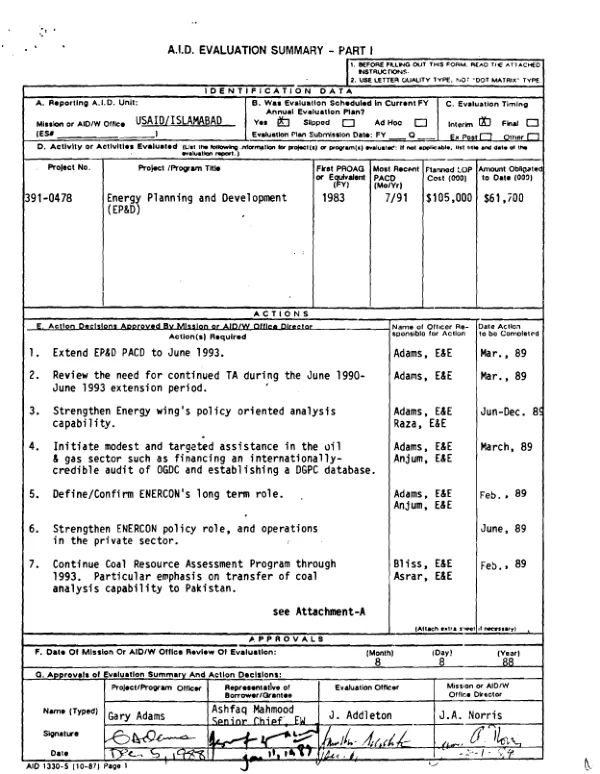
Abstract
The evaluation covers the period FY83-7/88. Despite a complex design, the project has been highly successful. (1) Computer equipment and TA have strengthened the Energy Wing of the Ministry of Planning Development, although policy-oriented work needs to be emphasized over technical and financial responsibilities. (2) Coal resource assessments at Lakhra have been encouraging, and these activities will continue, with emphasis on transferring assessment capacities to the Geological Survey of Pakistan. (3) The project also funded feasibility studies and environmental/social impact assessments to pave the way for commercial coal mining at Lakhra"s "PMDC Tract." Private sector mining at the site is expected to be a reality soon. It is recommended that the project assist in negotiating with private firms and and developing health and safety measures for the mine and that it fund a small training mine in the Sind. (4) Market tests of project-developed coal briquettes have been inconclusive, and users have complained that the briquettes do not provide enough heat for cooking. Moreover, projected manufacturing costs indicate that briquettes could not compete with currently used fuels. Continued testing is recommended, with a re-evaluation in 1990. (5) The National Energy Conservation Center (ENERCON) was established by the GOP in 12/86 after an 18-month delay. Since then, commendable progress has been made in developing private sector capabilities to provide energy audit technical services. It is recommended that ENERCON also develop an effective coordination role in public sector energy conservation. (6) GOP policy on renewable energy is fragmented, and in disagreement with USAID/P. Thus, few concrete actions have been taken in this area. In general, the overall project objective should be shifted from energy self-sufficiency to obtaining low-cost energy, particularly oil and gas. The PACD has been extended to 6/93. Several lessons were learned. (1) Bureaucratic procedures should be fully understood before project schedules are developed. (2) If priorities are not assigned by the host country, prospects of timely execution are small. (3) Agreements should be reached on the type of TA expertise needed before a contractor is selected. (4) TA contractors must be able to work closely with host country counterparts. (5) Complex projects involving large funding commitments should be scheduled for independent evaluations as early as possible.