USAID DEC
Enhancing Capacity for Low Emission Development Strategies (EC-LEDS) Clean Energy Program
Sign inUSAID
Enhancing Capacity for Low Emission Development Strategies (EC-LEDS) Clean Energy Program
The EC-LEDS Clean Energy Program in Georgia is focused on enhancing the country's capacity for low emission development strategies.
2016 · 3 pages
Sign in to readA free account is required to download.
Abstract
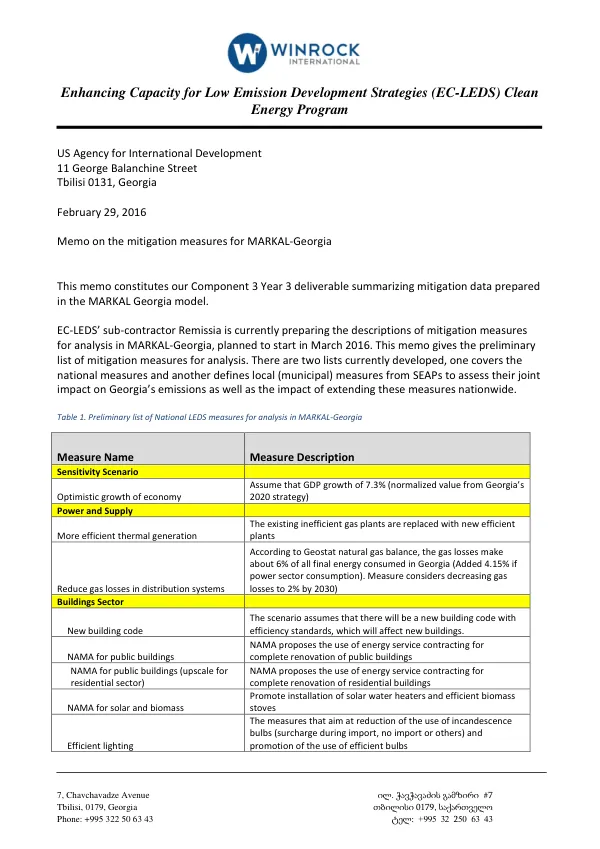
The program is implemented by the US Agency for International Development (USAID) and is based in Tbilisi, Georgia. The program's Component 3 Year 3 deliverable is a memo on mitigation measures for MARKAL-Georgia, a model used to analyze energy and emissions scenarios in the country. The memo outlines the preliminary list of mitigation measures for analysis in MARKAL-Georgia, which includes both national and municipal measures. The national measures are aimed at reducing greenhouse gas emissions across the country, while the municipal measures are focused on reducing emissions at the local level. The measures include a range of interventions, such as increasing energy efficiency in buildings, promoting the use of renewable energy sources, and improving transportation systems. The national measures include the implementation of a new building code with efficiency standards, the promotion of energy service contracting for the renovation of public buildings, and the installation of solar water heaters and efficient biomass stoves. Other measures include the labeling of appliances, the promotion of modal shift to rail in freight transport, and the introduction of vehicle mandatory inspection and improved fuel standards. The municipal measures include a range of interventions, such as building insulation, biomass heating systems, and solar water heaters in municipal buildings. In the residential sector, measures include building insulation, solar water heaters, and biomass heating systems in private houses. In the transport sector, measures include the improvement of public transportation systems, the development of public transportation systems where they do not exist, and the substitution of existing buses with Compressed Natural Gas (CNG) buses. The memo also notes that there is a delay in preparing measures for the industry sector due to the delayed signing of questionnaires by the Ministry of Economy and Sustainable Development. Remissia, the sub-contractor of EC-LEDS, plans to finalize this survey by mid-March, which will enable the definition of measures in this sector. The implementation of these mitigation measures is expected to have a significant impact on reducing greenhouse gas emissions in Georgia. The measures are designed to be implemented in a phased manner, with the national measures being implemented first, followed by the municipal measures. The implementation of these measures is expected to contribute to the achievement of Georgia's climate change mitigation goals and to support the country's transition to a low-carbon economy.
Related documents