USAID DEC
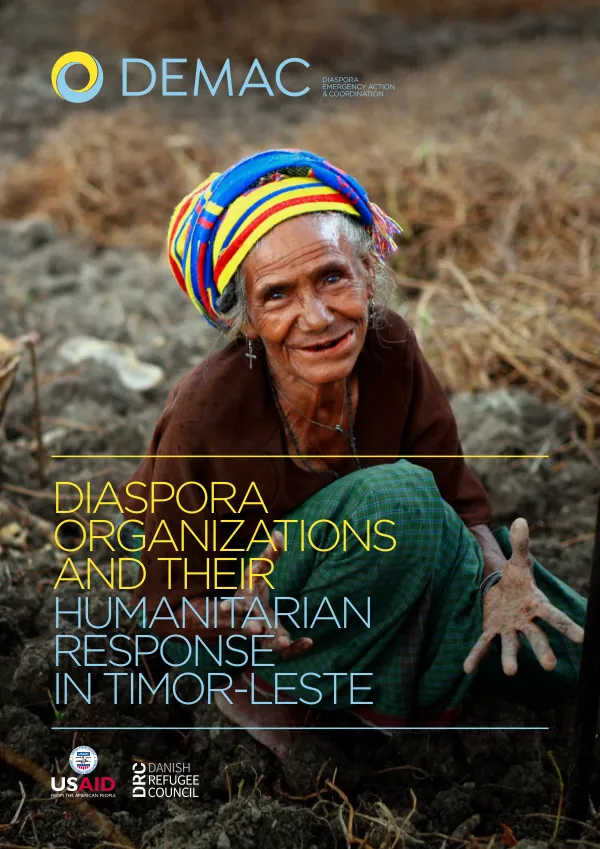
Enhancing Coordination in Humanitarian Settings: Diaspora Organizations and Their Humanitarian Response in Timor-Leste
Sign inUSAID DEC
Enhancing Coordination in Humanitarian Settings: Diaspora Organizations and Their Humanitarian Response in Timor-Leste
The DEMAC research teams would like to thank the members of diaspora communities in Timor-Leste and across the world, as well as the representatives of donors, UN agencies, NGOs, government officials, and other actors who dedicated their time providing information and sharing their valuable knowledge and experiences.
2021 · 27 pages
Sign in to readA free account is required to download.
Abstract
This real-time review is made possible by the generous support of the American people through the United States Agency for International Development (USAID). The contents are the responsibility of the Danish Refugee Council on behalf of DEMAC and do not necessarily reflect the views of USAID or the United States Government. Real-time review was conducted between April and June 2021, and the report was published in August 2021. The mission of DEMAC is to enable inclusive coordination and collaboration among diaspora organizations providing humanitarian assistance and across diaspora organizations and institutional humanitarian actors. The objective is to contribute to transforming the humanitarian ecosystem by laying the groundwork for a deeper understanding of diasporas as humanitarian actor groups with different modus operandi for the implementation of aid in practice. Diaspora organizations are multi-sectoral, fast responding actors who work transnationally, including in countries facing humanitarian crises. They have a connection with and understanding of their country of origin or heritage, which plays a vital role in humanitarian assistance. Diaspora organizations are key actors when it comes to raising the alarm in times of crisis, collecting and dispersing funds rapidly, and responding to the growing demands for remote management and cross-border response in countries where international actors have a limited presence. Supporting diaspora as part of a broader humanitarian ecosystem to play a key role in humanitarian responses and provide vital support to communities in countries of origin contributes to the relevance, effectiveness, and sustainability of humanitarian responses. In light of their transnational identity and close local ties, it is also strongly linked to the localization agenda, one of the main commitments under the Grand Bargain. Localization aims to strengthen the resilience of local communities and to support local and national responders on the front line. DEMAC has been a key factor behind stronger representation and visibility of diaspora organizations in the humanitarian ecosystem. DEMAC has piloted concrete liaison structures between diaspora and institutional humanitarian actors towards improving operational coordination in specific crisis settings. DEMAC has also conducted a number of studies aiming to increase understanding of motivations and modus operandi of diaspora humanitarian engagement, replacing assumptions with evidence on diaspora contribution. Building on these experiences and the past and present research, DEMAC will develop an operational framework for diaspora and humanitarian actors to improve future responses to humanitarian emergencies. Through the development of a standardized approach for the international humanitarian system to assess and document the role and impact of diaspora in selected emergency responses, DEMAC will enhance the knowledge and awareness of the nature and significance of the diaspora. DEMAC will also use the documentation from selected diaspora emergency responses to engage with diaspora humanitarian actors to enhance the generation of lessons learned and self-reflections from diaspora-led emergency responses. DEMAC will develop guidelines, tools, and resources in support of diaspora emergency engagement, with a view to remain prepared to support diaspora organizations' engagement in new emergency responses and facilitate coordination among responding diaspora organizations and between diaspora organizations and the humanitarian system. DEMAC is currently working with five selected emergency-prone focus countries, while at the same time remaining prepared to engage with and support diaspora from additional countries should a humanitarian crisis unfold in their country of origin. The report highlights the importance of diaspora organizations in humanitarian responses, their unique advantages, and the need for better coordination and collaboration between diaspora and institutional humanitarian actors. DEMAC's work aims to enhance the knowledge and awareness of the nature and significance of the diaspora, facilitate internal discussions on how the system could and should relate to and coordinate with diaspora emergency actors, and develop guidelines, tools, and resources in support of diaspora emergency engagement.