CATHOLIC RELIEF SERVICES ORGANIZATION
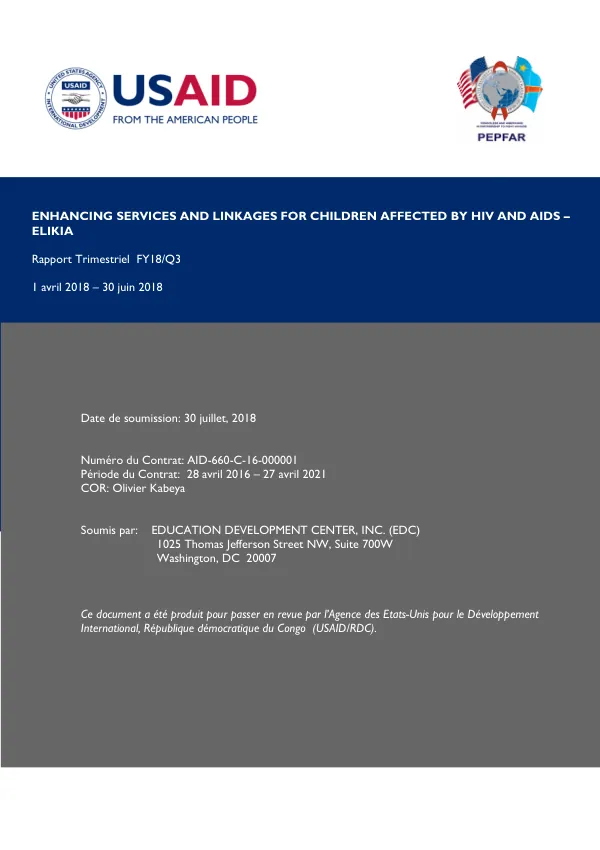
Enhancing Services and Linkages for Children Affected by HIV and AIDS – ELIKIA
Enhancing Services and Linkages for Children Affected by HIV and AIDS – ELIKIA is a five-year project attributed to Education Development Center (EDC) by the United States Agency for International Development (USAID/RDC) to improve the health, well-being, and economic security of orphans and vulnerable children (OVC) in five targeted health zones in the Haut-Katanga Province of the Democratic Republic of Congo.
2018 · 37 pages
Sign in to readA free account is required to download.
Abstract
The project aims to reduce the economic vulnerability of target households to meet the essential needs of children under their care, increase the use of essential services among OVC and their households, and strengthen the provincial and territorial social protection systems of the DRC. The project has made significant progress in achieving its objectives. As of the end of Q3, ELIKIA has enrolled 11,409 OVC_SERV, exceeding its annual target by 11.117. Among these, 11,147 are active beneficiaries, 262 have graduated (214 in T2 and 48 in T3), and the breakdown of OVC_SERV by age, sex, and health zone is presented in Annex B. The project has also achieved 91% of its annual target for OVC under 18 years, with 8,662 OEV enrolled during the quarter. ELIKIA has continued to work on reducing the number of beneficiaries who do not know their HIV status. The project has also made progress in providing economic strengthening, skill acquisition for parents, and strengthening referral systems and linking vulnerable households to health and social services. The project has established 125 savings and internal lending communities (SILC) that benefit 1,800 vulnerable households, generating shared savings to support 10,000 individual beneficiaries. The project has also made significant progress in achieving its intermediate results, including providing economic strengthening to 700 highly vulnerable households, establishing 30 child protection committees in the targeted health zones, and completing organizational development evaluations and annual planning with the Division of Social Affairs (DIVAS) of Haut-Katanga. The project has also issued at least $1,000,000 in small grants to 4-6 civil society organizations to provide support and services to OVC households. The project has also established a provincial-level technical working group on OVC in the Haut-Katanga Province. The project has also made progress in providing education support to 2,000 beneficiaries through direct support and school scholarships. The project has also formed 22 community animators to provide parenting education sessions and 64 case managers to evaluate vulnerability, manage cases, and facilitate referrals. The project has also made significant progress in strengthening the capacity of health and social service providers in the provinces, districts, and communities to provide a coordinated continuum of care to OVC. The project has also established a system for monitoring and evaluating the performance of the project, including the use of the Child Status Index (CSI) and the Household Vulnerability Assessment Tool (HVAT). Overall, the project has made significant progress in achieving its objectives and has established a strong foundation for continued progress in the coming quarters. The project has also established a strong partnership with the Government of the Democratic Republic of Congo, civil society organizations, and other stakeholders to ensure the sustainability of the project's outcomes. The project has also identified several challenges and opportunities for improvement, including the need to strengthen the capacity of community-based organizations to provide services to OVC, the need to improve the efficiency of the referral system, and the need to increase the use of technology to support the project's monitoring and evaluation activities. The project has also identified opportunities for collaboration with other projects and initiatives to leverage resources and expertise. The project has also established a system for monitoring and evaluating the performance of the project, including the use of the Performance Monitoring & Evaluation Plan (PMEP) and the Initial Environmental Examination (IEE). The project has also established a system for reporting on progress and outcomes, including the use of the Management Information System (MIS) and the Organizational Capacity Assessment Plus Tool (OCA-Plus). The project has also made significant progress in strengthening the capacity of health and social service providers in the provinces, districts, and communities to provide a coordinated continuum of care to OVC. The project has also established