USAID DEC
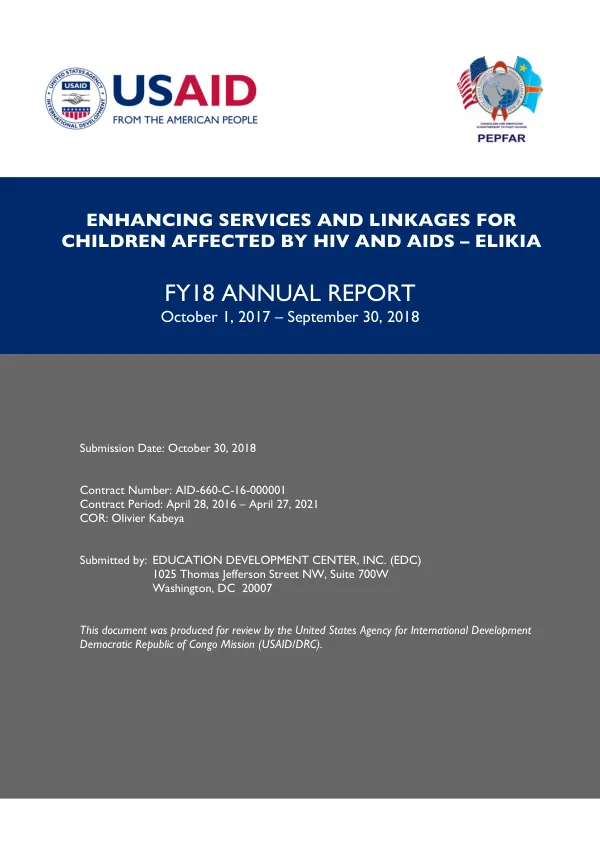
Enhancing Services and Linkages for Children Affected by HIV and AIDS – ELIKIA FY18 Annual Report
Sign inCATHOLIC RELIEF SERVICES ORGANIZATION
Enhancing Services and Linkages for Children Affected by HIV and AIDS – ELIKIA FY18 Annual Report
The ELIKIA program is a five-year initiative aimed at improving the health, wellbeing, and economic security of orphans and vulnerable children (OVC) in the Democratic Republic of the Congo.
2018 · 36 pages
Sign in to readA free account is required to download.
Abstract
The program is implemented by Education Development Center, Inc. (EDC) in collaboration with Catholic Relief Services (CRS), Palladium Group, and Caritas Katanga. The program's objectives include reducing economic vulnerability of target households, increasing utilization of essential services among OVC and their households, and strengthening the Government of the Democratic Republic of Congo (GDRC) provincial and district social welfare systems. During FY18, the program supported 11,611 beneficiaries, exceeding the target of 11,117 (104% of target). A total of 10,642 beneficiaries were active at the end of FY18, and 969 graduated during the year. The beneficiaries included 8,896 (77%) OVC under the age of 18 and 2,715 (23%) individuals over the age of 18, including caregivers, spouses, and household members. The program began graduating beneficiaries in Q2 of FY18, with the greatest number of graduated beneficiaries recorded in Q4 (753). The program's activities included economic strengthening, skill-building for parents and caregivers, strengthening referral systems, and linking vulnerable households to health and social services. The program also built capacity of actors within the provincial, district, and community health and social service sectors to effectively provide for the needs of OVC with a coordinated continuum of care. The program's results included supporting 11,611 OVC and caregivers from 4,600 vulnerable households, delivering cash transfers to 700 highly vulnerable households, establishing 125 savings groups benefiting 1,800 vulnerable households, and training 500 savings group participants in entrepreneurship training. The program also developed a package of tailored parenting education sessions, a provincial social service referral toolkit, and zonal-level social service guides. The program's geographic coverage included Haut-Katanga Province, where activities were implemented throughout the year, and Lualaba Province, where activities began in August 2018. The program's reporting period was from October 1, 2017, to September 30, 2018. The program's overall performance was satisfactory, with some challenges and proposed solutions identified in the report. The program's key issue narrative highlighted the importance of addressing the economic vulnerability of target households, increasing utilization of essential services among OVC and their households, and strengthening the GDRC provincial and district social welfare systems. The program's integration of cross-cutting issues and USAID Forward priorities included gender equality and female empowerment, sustainability mechanisms, environmental compliance, and local capacity development. The program's stakeholder participation and involvement included collaboration with the Division of Social Affairs (DIVAS), the Ministry of Social Affairs (MINAS), and other local organizations. The program's lessons learned highlighted the importance of building capacity of local actors, strengthening referral systems, and linking vulnerable households to health and social services. The program's management and administrative summary provided an overview of the program's financial and administrative performance during FY18. The program's planned activities for the next quarter included continuing to support OVC and caregivers, delivering cash transfers, establishing savings groups, and training participants in entrepreneurship training. The program's actions taken to address A/COR comments included addressing concerns related to program implementation, monitoring, and evaluation. The program's progress summary provided an overview of the program's achievements during FY18, including the number of beneficiaries supported, the number of savings groups established, and the number of participants trained in entrepreneurship training. The program's overall performance was satisfactory, with some challenges and proposed solutions identified in the report.
Related documents