CARANA CORPORATION, INC.
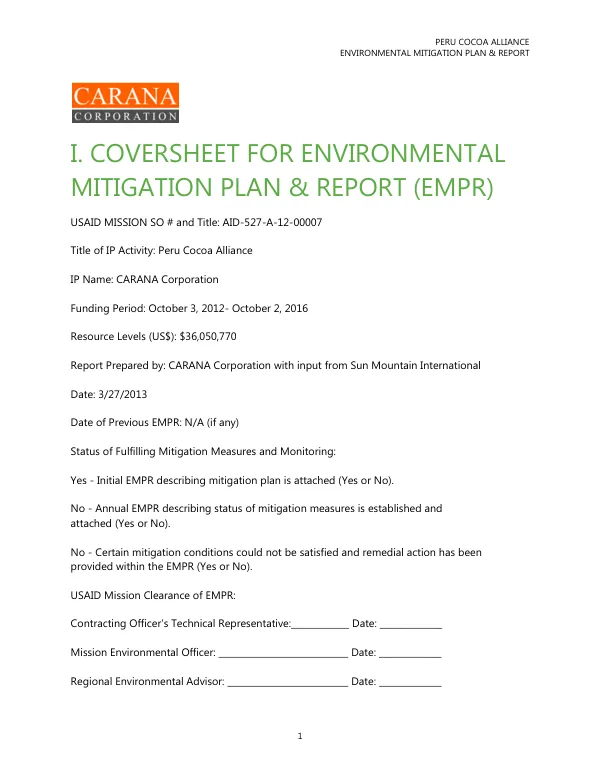
Environmental Mitigation Plan & Report for Peru Cocoa Alliance
The Peru Cocoa Alliance aims to promote alternative economic development in former coca-growing areas of Peru.
2013 · 46 pages
Sign in to readA free account is required to download.
Abstract
The Alliance will work with Peruvian smallholder farmers in the regions of Huánuco, Ucayali, and San Martín to increase their standards of living by providing connections to producer organizations and resource providers – with particular focus on cocoa – to establish sustainable value chains. According to USAID, despite a decade of sustained economic growth, democratic governance, and overall poverty reduction, the socio-economic benefits of Peru's development have not reached certain segments of the population, including the Amazon Basin where coca is grown. Cocaine trafficking has resulted in violence and conflict that is a threat to Peru's current economic growth, democracy, and stability. The cultivation of coca has continued to increase in Peru among vulnerable rural farming communities. These populations are often lacking sufficient economically viable alternatives infrastructure, social services, and governance to encourage them to select alternative cultivation strategies. Coca has taken a toll on Peru's environment, as well. Coca is normally grown as an intensive monocrop. Without rotation, coca can degrade the environment and fertility of the land. This cultivation system also leaves the plants susceptible to more pests and diseases. To combat these pitfalls, farmers are increasingly applying more agro-chemicals to their fields, which has also in turn polluted Peru's soils further and put at risk the nearby groundwater and surface water resources. The Peru Cocoa Alliance has developed an extensive partner network to implement the Alliance. CARANA Corporation has collaborated with Source Trust, which will provide extension and training to farmers, as well as develop and propagate certified planting and fine flavor materials. Source Trust will be reaching out to resource partners, including Armajaro Trading Limited, which guarantees a market for all cocoa produced via the program; Geo-Traceability, which will develop a system for the Alliance that establishes supply chain transparency for buyers; BioScipher, which will establish laboratories and nurseries for propagating high volumes of fine flavor cocoa planting material; and Casa Luker, which will support agro-forestry demonstration plots, clonal gardens, and training. AZMJ will be taking responsibility for providing access to finance, as well as ensuring financial literacy among farmers. The environmental compliance strategy being developed offers long-term sustainability as part of the Alliance services platform, thus transforming environmental compliance from an external system implemented by and for USAID to an integral component of agricultural development in rural Peru, implemented by and for the producers and buyers. The Alliance has three objectives: agricultural value chain promotion and expansion, access to finance, and Alliance services. Expected outputs/results include 28,000 hectares of additional cocoa under cultivation, 5 sustainable value chains linking strategic buyers to aggregators/producer organizations, farmers, financing, and service providers, and 23,000 hectares incorporated into a traceability system. The target regions for this program are Huánuco, Ucayali, and San Martín. Areas of implementation include San Martin: Pongo de Caynarachi – Papaplaya, Saposoa – Alto Biavo, Huallabamba, Valle del Sion – Mishollo; Huanuco: Paraiso-Yanajanca-Aucayacu-Bolsón Cuchara, Tournavista – Yuyapichis; and Ucayali: Pongo de Caynarachi – Papaplaya, Saposoa – Alto Biavo, Huallabamba, Valle del Sion – Mishollo. The Alliance aims to establish a sustainable and inclusive cocoa value chain that promotes economic development, protects the environment, and supports the well-being of smallholder farmers and their communities.
Related documents