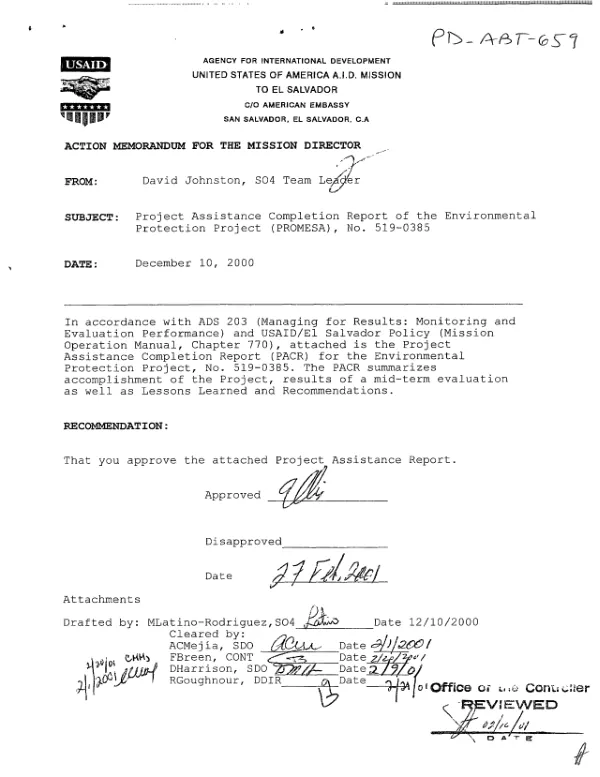
USAID. MISSION TO EL SALVADOR
Environmental protection project
Evaluates project to improve environmental and natural resource management (NRM) in El Salvador (EEP project).
1997
Sign in to readA free account is required to download.
Abstract
Mid-term evaluation covers the period 3/93-5/97. Notable progress has been made in increasing awareness and concern about environmental problems, developing mass media capacities to continue this process, and, to a lesser extent, in internalizing selected institutional capacities for environmental education. However, no significant progress has been made in enhancing a national capacity to carry out environmental protection and NRM policy reforms, though the recent creation, supported by the project, of an environmental ministry bodes well in this area. Results have been mixed in developing and diffusing NRM technology to small farmers. There has been no significant progress in enhancing related institutional capacities. In the area of policy reform, the project assisted the preparation and public consultation of a draft comprehensive environmental law and of draft forestry and protected areas laws, and is working on a draft forestry incentives law. Augmenting and training extension agents of the Centro de Tecnologia Agropecuaria y Forestal (CENTA) strengthened institutional capacity for transferring soil and water management and agroforestry technologies to the target population of small, hillside farmers in the demonstration area (DA). However, removal of counterpart-funded CENTA extensionists in late 1996 and creation of a parallel group of Green Project/Executive Secretariat for the Environment (SEMA) training specialists with NGO supervisors has slowed progress in achieving DA objectives. GreenCom, the TA contractor, has made good progress in helping to establish environmental education and communications (EE/C) technical units in the Ministry of Education, SEMA, and the Parks and Wildlife Division (PANAVIS) of Ministry of Agriculture (MAG). GreenCom has also assisted the Ministry of Education in preparing teacher guides for including environmental topics in primary education, supported SEMA environmental media campaigns, and worked with environmental journalists, newspaper, and television channels to develop and disseminate better quality environmental information. A project-supported national environmental journalism awards program has significantly increased the quantity and quality of coverage of environmental issues by major newspapers and television channels over the past 2 years. The mid-1995 decision to initiate a Community Conservation Program (CCP) to assist in installing latrines, stoves, wells, and pumps, has diverted financial and technical resources from testing NRM practices and transfer methodologies and seems more appropriate for the Mission"s health strategic objective. Lessons learned are as follows. (1) Following the standard sequence of steps required for environmental and NRM policy reform -- development of a common strategy, elaboration of a policy framework, and the proposal and passing of legislation -- has proven difficult for much of this project"s life. (2) In countries such as El Salvador, where it is customary for the executive branch to submit legislation to the legislature for approval, proposed legislation must conform to the vision, strategy, and policy framework of the incumbent executive branch and be thoroughly reviewed and approved by that branch prior to its submission to the legislature. This procedure was not followed in the case of the environmental law developed under EEP. As a result, different versions of the law have shuffled back and forth between the legislature and the executive branch, and there are serious doubts whether it should be acted upon at all in its present form. (3) In a project as complex as EEP, with many actors and overlapping jurisdictions, it is important to clearly define the respective roles of each and formalize them in writing. If CENTA, SEMA, and the TA team had tried to agree on a common approach to NRM technology transfer, much more progress could have been made toward developing and diffusing solid and water conservation and agroforestry technologies. (4) Environmental journalists can play a critical role in raising public awareness and concern about environmental issues, especially on water-related issues.
Related documents