NOTRE DAME UNIVERSITY
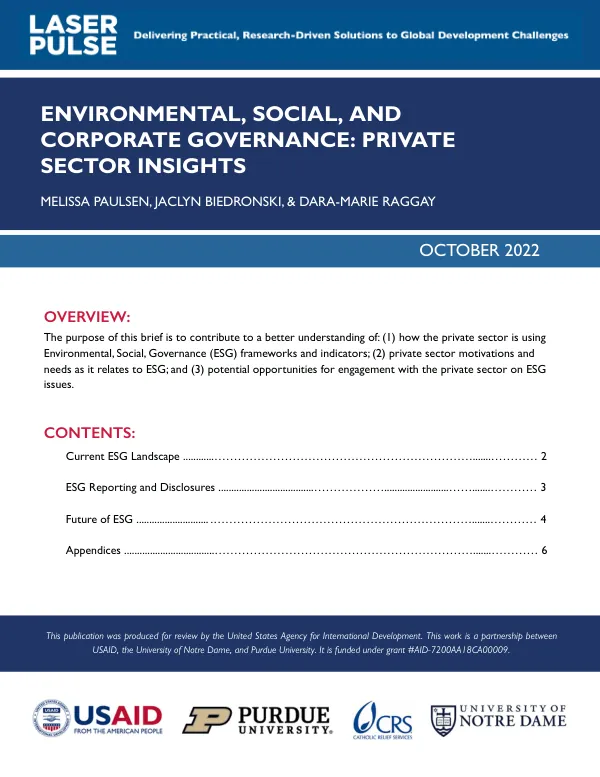
Environmental, Social, and Corporate Governance: Private Sector Insights
The private sector's approach to Environmental, Social, and Governance (ESG) frameworks and indicators is a critical aspect of responsible investing.
2022 · 34 pages
Sign in to readA free account is required to download.
Abstract
ESG encompasses determining factors and criteria for responsible investing, including environmental, social, and governance criteria that are non-financial but have the potential to result in positive or negative financial impacts. The environmental criteria consider a company's impact on nature, social criteria consider a company's relationship with its employees, suppliers, customers, and host communities, and governance criteria consider transparency, accountability, and integrity in leadership structures. Materiality assessments form the basis of ESG reporting in mainstream capital markets, as they assist in determining the relative importance of various ESG opportunities and risks for specific companies. ESG guidelines and principles may deliver better financial returns, lower financial risk, or an improved corporate image. Additional incentives for companies to prioritize ESG investments include attracting and retaining investments, reducing vulnerability to current and future risks, informing future economic and financial decisions, satisfying stakeholder demands and maintaining trust, ensuring compliance with regulatory or legislative bodies, determining the company's relative performance on ESG issues, and gaining and maintaining competitive advantage or industry leadership. The audience for ESG disclosures is diverse, with a wide array of shareholders and stakeholders having demonstrated interests in ESG. This includes corporate leadership, shareholders, clients, customers, and consumers, as well as ESG rating and ranking agencies, data and business analytics platforms, broader Civil Society, and government actors. ESG reporting frameworks prioritize measurable goals and quantitative results, yet there are dozens of ESG disclosure systems that vary widely. The most commonly used reporting systems include the Global Reporting Initiative (GRI), the CDP (formerly the Carbon Disclosure Project), the Sustainability Accounting Standards Board (SASB), and the Taskforce on Climate-Related Financial Disclosures (TCFD). Investors are continually demanding greater usability and consistency in sustainability and ESG-related disclosures so that they can make sound financial decisions. Some of the most influential global investors have formed partnerships in favor of standardized reporting frameworks. Challenges and limitations associated with ESG standards, ratings, and frameworks include too many frameworks to navigate, limited guidance on where to start, and what and how to disclose, as well as duplication, inconsistency, and incomparability between frameworks. Due to increased demands from investors, more government regulation is expected in the US, especially on the part of the US Securities and Exchange Commission (SEC). ESG regulation in Europe is also expected to impact the decisions of US corporations, especially those operating internationally. Global economic disruptions resulting from COVID-19 or large-scale violence have the potential to catalyze shifts in global power dynamics and could significantly impact ESG priorities and/or global uptake of US frameworks. The mainstreaming of public awareness and advocacy around Diversity, Equity, and Inclusion (DEI), climate change, information privacy, as well as other social and environmental issues, will continue to be important determinants in ESG disclosures because of the impact on corporate image and financial performance. The private sector's engagement with ESG is a critical aspect of responsible investing, and companies are increasingly prioritizing ESG investments due to the potential for better financial returns, lower financial risk, and an improved corporate image. The audience for ESG disclosures is diverse, and companies are using a range of reporting frameworks to disclose their ESG performance. However, challenges and limitations associated with ESG standards, ratings, and frameworks remain, including too many frameworks to navigate and duplication, inconsistency, and incomparability between frameworks.
Related documents