USAID DEC
Possible Research and Evaluation Questions, and Candidate Indicators, to Consider When Attempting to Measure Commitment in a Ugandan Community
Sign inCATHOLIC RELIEF SERVICES ORGANIZATION
Possible Research and Evaluation Questions, and Candidate Indicators, to Consider When Attempting to Measure Commitment in a Ugandan Community
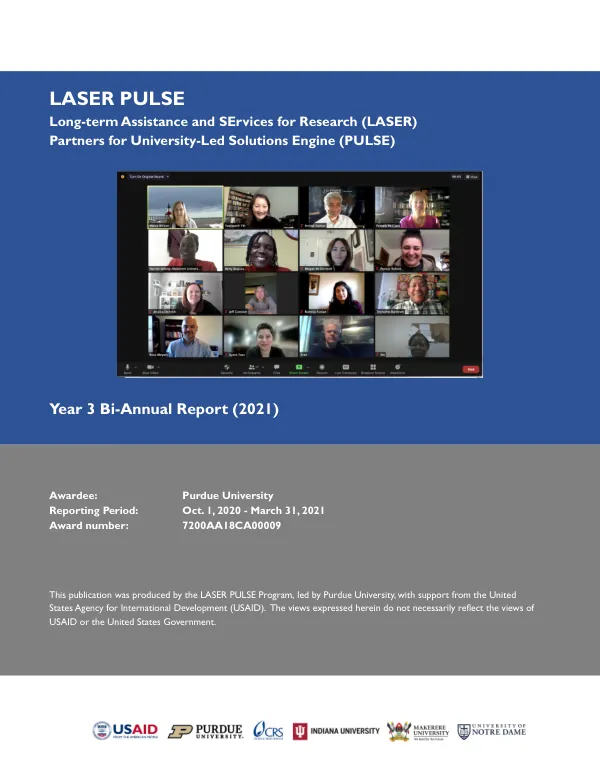
The Long-term Assistance and Services for Research (LASER) Partners for University-Led Solutions Engine (PULSE) program is a five-year, $70M initiative funded through USAID's Innovation, Technology, and Research Hub.
2021 · 7 pages
Sign in to readA free account is required to download.
Abstract
The program delivers research-driven solutions to field-sourced development challenges in USAID interest countries. A consortium led by Purdue University, with core partners Indiana University, the University of Notre Dame, Makerere University, and Catholic Relief Services, implements the LASER PULSE program through a growing network of 2,300+ researchers and development practitioners in 56 countries. The program collaborates with USAID missions, bureaus, and independent offices and other local stakeholders to identify research needs for critical development challenges, and funds and strengthens capacity of researcher-practitioner teams to co-design solutions that translate into policy and practice. The LASER PULSE program focuses on developing participatory measures of commitment in Ugandan communities, with a specific case study conducted in Laredo, Uganda. The research, evaluation, and learning questions, along with candidate indicators, emerged from the case study and aim to measure commitment in a Ugandan community. The questions and indicators are organized around several themes, including presence of bylaws, committee engagement, planning, feedback system, equal representation, national-level policies, MEL plan, community-based organizations, women's empowerment, and community engagement/community ownership. Possible research and evaluation questions include: What are the rules regarding the equal representation of marginalized groups in the organization? How does the program ensure transparency between various actors of the organization? Are there any government rules present to ensure transparency/equal representation? What are they? Are they used locally? Are there any checks and balances to ensure that they are implemented at the local level? Candidate indicators for these questions include: percentage of leadership positions occupied by women (or other marginalized group representatives) in the community, frequency of committee meetings within a specific period of time, degree to which community members report that their leadership provides an environment for free and open expression of ideas/opinions/beliefs/etc., and degree to which community members report that their leadership regularly makes information about how diverse the representatives in leadership team(s) are available to the public. The LASER PULSE program also focuses on planning, with research and evaluation questions such as: How do organizations plan for activities? Is the planning process participatory? Who is involved in the planning process? How are the decisions made: collectively or individually? Candidate indicators for these questions include: degree to which community members perceive that their leaders meet the needs of women/marginalized individuals when planning community activities, degree to which community members perceive that their leaders seek feedback from women/marginalized groups when making decisions that affect the community, and degree to which leaders engage community members in the process of implementing community activities. In addition, the program explores the concept of feedback systems, with research and evaluation questions such as: Are there reports produced to track the progress of organizations? Are these reports publicly available? Are there annual/monthly meetings/open dialogues with stakeholders to get feedback on project progress? Candidate indicators for these questions include: degree to which leaders are transparent about how they intend to use the feedback information community members share with them, number of participatory meetings, and number of records that are publicly available. The LASER PULSE program also examines the concept of equal representation, with research and evaluation questions such as: How are resources distributed to marginalized sections of the population? Is there a preference for redistribution, like rationing? Do parents send both girls and boys to school? Candidate indicators for these questions include: percentage of boys vs girls in a given family that are sent to school, percentage of women that have savings/financial assets separate from their husbands, and number/percent of male and female candidates in the committee. Finally, the program explores the concept of community engagement/community ownership, with research and evaluation questions such as: Were the community members informed about the program, its goals, its community members, and its intended benefits and limitations? Are there frequent dialogues organized between organizations and communities? Candidate indicators for these questions include: frequency of organized dialogues with community members, percentage/number of community members who participate in leadership meetings to discuss community-related issues, and degree to which community members feel comfortable/safe voicing their opinions.