USAID DEC
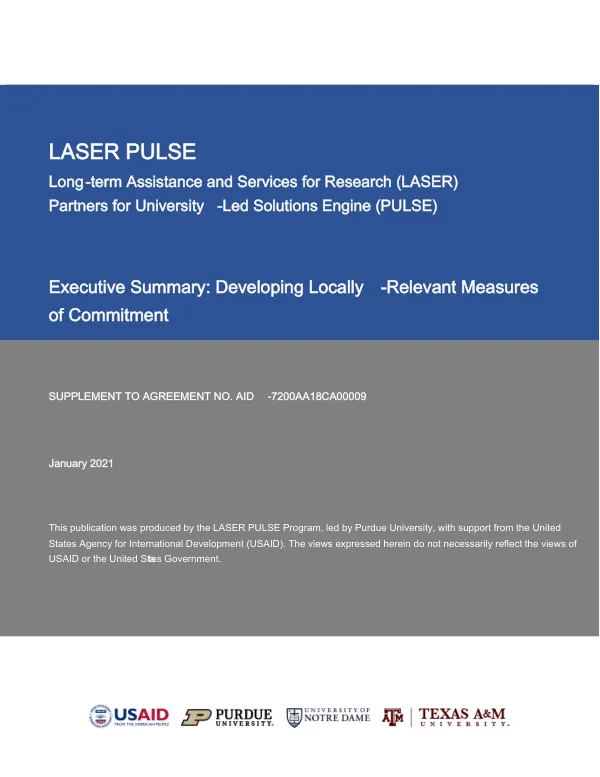
Supplement to Agreement NO. AID-7200AA18CA00009: Developing Locally Relevant Measures of Commitment
Sign inCATHOLIC RELIEF SERVICES ORGANIZATION
Supplement to Agreement NO. AID-7200AA18CA00009: Developing Locally Relevant Measures of Commitment
The LASER PULSE program is a five-year, $70M initiative funded through USAID's Innovation, Technology, and Research Hub.
2021 · 4 pages
Sign in to readA free account is required to download.
Abstract
The program delivers research-driven solutions to field-sourced development challenges in USAID interest countries. A consortium led by Purdue University, with core partners Indiana University, the University of Notre Dame, Makerere University, and Catholic Relief Services, implements the LASER PULSE program through a growing network of 2,300+ researchers and development practitioners in 56 countries. The program collaborates with USAID missions, bureaus, and independent offices, as well as other local stakeholders, to identify research needs for critical development challenges. LASER PULSE funds and strengthens the capacity of researcher-practitioner teams to co-design solutions that translate into policy and practice. The program's focus is on developing locally relevant measures of commitment, which is a key component of the Journey to Self-Reliance. A collaborative research study was designed to provide guidance to USAID staff and other stakeholders on articulating potential indicators and approaches for understanding commitment. The study used the Everyday Peace Indicators (EPI) methodology, which is built on participatory research methods where local communities are best placed to conduct research to understand the local-level context. The study explored local level commitment in two sectors, education and health, as well as from a gender perspective in a local Ugandan community. The study used a qualitative case study methodology and focused on participants of the Just Like My Child (JLMC) NGO training program in Laredo, Uganda. The research team developed four personas to characterize the commitment that community leaders and members perceive and expect. The personas reflected the aggregate of different program participants' and community leaders' perspectives and priorities regarding commitment data. The study also produced candidate evaluation and research questions to consider when interrogating the locally relevant conceptualization of commitment. The research team documented their pilot process for developing indicators of commitment, which could be used by USAID staff or their implementing partners to develop locally relevant indicators of commitment that are relevant to their specific context. Developing these indicators of commitment in a participatory manner may help measure and understand changes to commitment that result from programmatic interventions, and/or changes to commitment that may influence the relative success of a given program. The study's findings and recommendations are intended to be used by USAID staff and implementing partners to develop locally relevant indicators of commitment that are tailored to their specific context. The LASER PULSE program's focus on developing locally relevant measures of commitment is critical to understanding the complex construct of commitment in different contexts. The program's approach to developing indicators of commitment is participatory and context-specific, which is essential for ensuring that the indicators are relevant and effective in measuring commitment in different settings. The program's findings and recommendations have the potential to inform the development of commitment indicators in other contexts and countries, and to contribute to a deeper understanding of the role of commitment in achieving development outcomes.