ADVANCED ENGINEERING ASSOCIATES INTERNATIONAL, INC. /SGGA
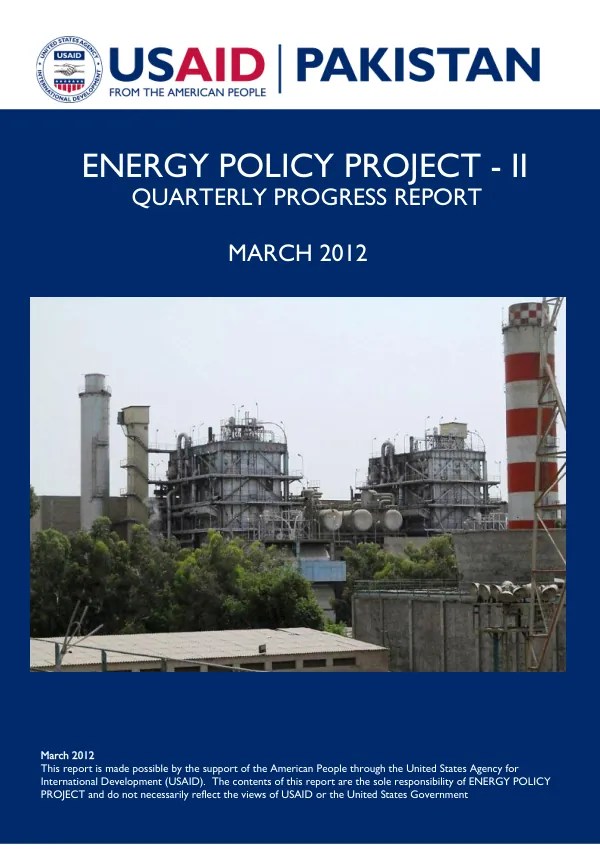
EPP Quarterly Report March 2012
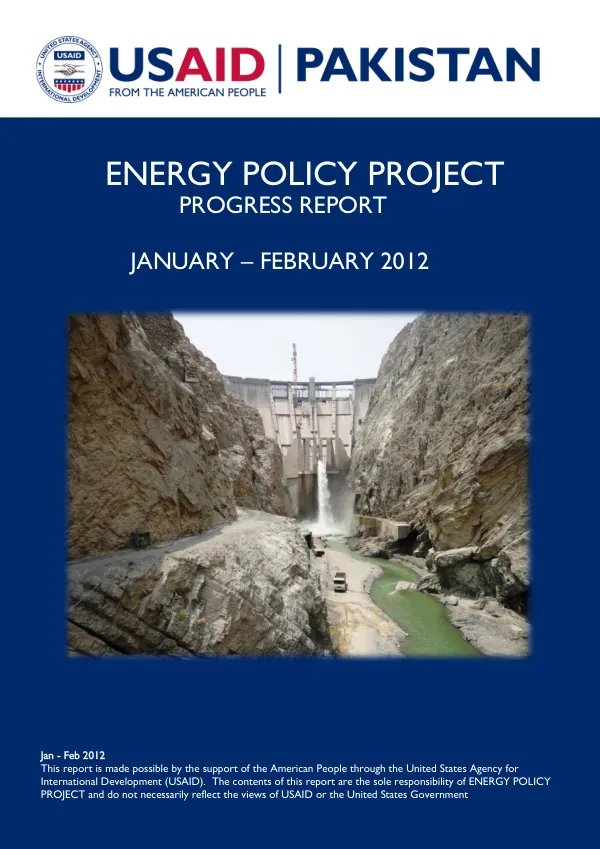
The Energy Policy Project (EPP) supports the jointly agreed upon interests of USAID and the Government of Pakistan (GOP) in power generation, transmission, and related policy reform activities.
2012 · 25 pages
Sign in to readA free account is required to download.
Abstract
Current key activities include providing monitoring and implementation support to six signature energy projects announced by the Secretary of State, Hillary Clinton. These projects, when completed, will add more than 888 MW to Pakistan's generation capacity. The six signature energy projects include four repair and maintenance projects and two multipurpose dam completion projects. The four repair and maintenance projects are focused on three Generation Companies (GENCOs) and Tarbela, with a total funding of $68 million. The two multipurpose dam completion projects are Gomal Zam and Satpara, with a total funding of $66 million. As of March 2012, a total of 423 MW have been added to Pakistan's grid. EPP is providing technical support to the Ministry of Water and Power (MWP) for identifying and selecting new generation and transmission projects. Examples of these projects include the import of electricity from Central Asian Republics to Pakistan through Afghanistan, providing analytical support for projects such as Step 1 Due Diligence for Diamer Basha, Kurram Tangi, Warsak, and Mangla Dam Projects, and issues related to these candidate projects. EPP is also supporting generation and transmission-related studies and policy reform activities assigned by USAID, development of GENCO and NTDC business plans, and developing policies and procedures for the National Power Control Center and advisory services at MWP and the Planning Commission (Energy Wing), Ministry of Finance, etc. The project has a staffing level of 85% Pakistani and 15% international staff, with a presence in all provinces and Federally Administered Tribal Areas. The total USAID funding for the project is $134.121 million, with $14.893 million allocated for FARAS and $119.228 million allocated for EPP Phase II. The project has made significant progress in terms of expected gains in production capacity. For example, the due diligence report on Guddu TPS initially indicated an expected increase of 55 MW in production capacity, but further de-ration of equipment has increased the expected gain to 100 MW. Similarly, the expected gains in production capacity for Muzaffargarh, Jamshoro, Tarbela, Gomal Zam, and Satpara are 440, 150, 128, 17.4, and 17.66 MW, respectively. The project financial summary is not publicly available due to confidential information. However, the project activities are focused on providing monitoring and implementation support to the six signature energy projects, technical support to the MWP for identifying and selecting new generation and transmission projects, and supporting generation and transmission-related studies and policy reform activities assigned by USAID.
Related documents