USAID DEC
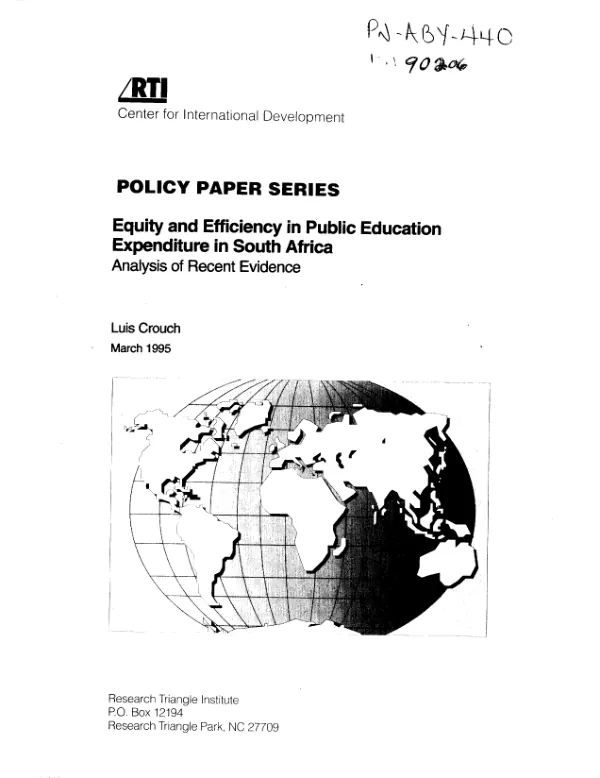
Equity and efficiency in public education expenditure in South Africa : analysis of recent evidence
Sign inACADEMY FOR EDUCATIONAL DEVELOPMENT, INC. (AED)
Equity and efficiency in public education expenditure in South Africa : analysis of recent evidence
Any attempt to provide free education for all in South Africa will result in a two-tiered system: (1) a mediocre or poor public education managed by persons whose children do not participate in it, and (2) a parallel private system for the children of the progressive elites.
Crouch, Luis · 1995
Sign in to readA free account is required to download.
Abstract
Thus concludes this analysis of recent data on South Africa"s education system. Major findings are: (1) public education cannot be made available freely to all, even at its currently dismal level of quality, without a budgetary explosion; (2) the existing educational subsidy system is inequitable, even within traditionally disadvantaged groups -- especially at the university level where scholarships are provided disproportionately to the relative elites within those groups; (3) because educational investments have favored certain groups (whites, Africans at university), returns in these areas are much lower than could be obtained by investing more in secondary education of Africans; (4) private willingness to pay for education is relatively high, indicating that fiscal savings or quality improvements could result from targeting subsidies toward the poor rather than providing free education to all. The paper concludes by recommending a multi-tiered system of subsidies, where effort in financing and governance is elicited from parents according to their ability to pay and organize. This would result in a unified system of national education combining elements of public and private but with no clear-cut division between the two.
![Interim ABET [adult basic education and training] Advisory Body : sectoral report](https://covers.devme.ai/gen/18896.webp)
![Improving educational quality project (IEQ) South Africa : from policy to practice -- implications from the IEQ educare study for monitoring and evaluation for the implementation of the interim ECD [early childhood development] policy](https://covers.devme.ai/gen/65658.webp)