USAID DEC
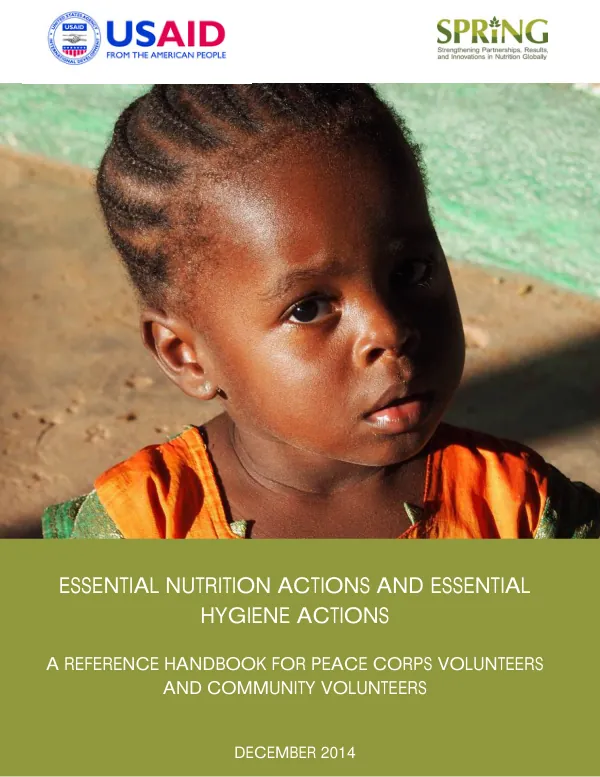
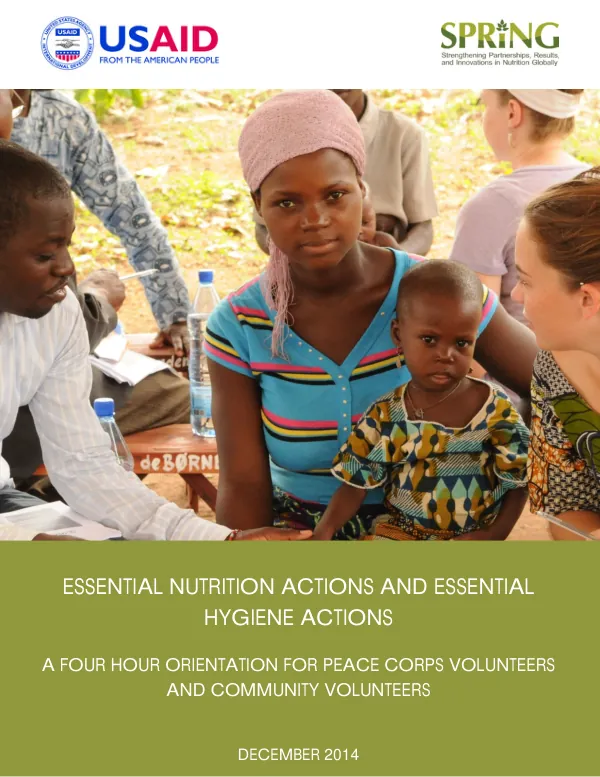
Essential Nutrition Actions and Essential Hygiene Actions: A Four-Hour Orientation for Peace Corps Volunteers and Community Volunteers
Sign inHELLEN KELLER INTERNATIONAL
Essential Nutrition Actions and Essential Hygiene Actions: A Four-Hour Orientation for Peace Corps Volunteers and Community Volunteers
Global Nutrition Efforts Around the world, approximately two billion people live on a diet lacking essential nutrients, resulting in chronic undernutrition among more than 200 million children under the age of five.
2014 · 26 pages
Sign in to readA free account is required to download.
Abstract
This undernutrition affects the 1,000-day window from conception to a child's second birthday, leading to mental impairment and long-term consequences, including susceptibility to sickness, poor academic performance, and reduced earning potential. The world community is responding to this situation with increasing urgency, focusing on global undernutrition, particularly among pregnant women and children under two years of age. The Scaling Up Nutrition (SUN) Movement has been endorsed by over 100 government, civil society, and university groups since 2010. This framework and roadmap are grounded in nutrition actions endorsed by The Lancet in its landmark series Maternal and Child Undernutrition, published in 2008 with an update in 2013. The 1,000 Days initiative, a global effort to implement the SUN framework and roadmap at the country level, was endorsed in 2010 by more than half a dozen ministers and heads of organizations. Peace Corps has identified nutrition as a key focus area of its interventions under Feed the Future, the United States government's global hunger and food security initiative. In 2011, Peace Corps and USAID signed the Global Food Security Agreement and USAID/West Africa Regional Mission, establishing the USAID/Peace Corps West Africa Food Security Partnership (WAFSP). This partnership facilitates opportunities for synergistic food security programming between West African Feed the Future focus countries and other targeted countries. Essential Nutrition Actions and Essential Hygiene Actions The Essential Nutrition Actions (ENA) framework is a set of nutrition actions proven to combat malnutrition during the critical first 1,000 days. These actions include improving maternal nutrition, promoting exclusive breastfeeding, and supporting infant and young child feeding practices. Essential Hygiene Actions (EHA) are also critical in preventing malnutrition, particularly in areas with limited access to clean water and sanitation. The ENA framework is grounded in evidence-based practices and has been endorsed by The Lancet. The framework includes eight Essential Nutrition Actions: improving maternal nutrition, promoting exclusive breastfeeding, supporting infant and young child feeding practices, improving household food security, promoting homestead food production, improving access to clean water and sanitation, promoting handwashing with soap, and providing micronutrient supplements. Peace Corps Volunteers and Community Volunteers play a crucial role in promoting and implementing Essential Nutrition Actions and Essential Hygiene Actions in their communities. They work closely with local partners to deliver training and support to community members, promoting behavior change and improving nutrition outcomes. Implementation of Essential Nutrition Actions and Essential Hygiene Actions requires a comprehensive approach, involving multiple stakeholders and sectors. This includes government agencies, civil society organizations, and community groups working together to address the root causes of malnutrition and improve nutrition outcomes. Monitoring and Evaluation Monitoring and evaluation are critical components of implementing Essential Nutrition Actions and Essential Hygiene Actions. This includes tracking progress towards nutrition outcomes, identifying areas for improvement, and making adjustments to programming as needed. The Stages of Change Model is a useful framework for understanding behavior change and promoting Essential Nutrition Actions and Essential Hygiene Actions. This model recognizes that behavior change is a process that occurs over time, involving multiple stages, including precontemplation, contemplation, preparation, action, and maintenance. In conclusion, Essential Nutrition Actions and Essential Hygiene Actions are critical in preventing malnutrition and improving nutrition outcomes. Peace Corps Volunteers and Community Volunteers play a crucial role in promoting and implementing these actions in their communities. A comprehensive approach, involving multiple stakeholders and sectors, is necessary to address the root causes of malnutrition and improve nutrition outcomes.
Related documents