ABT ASSOCIATES
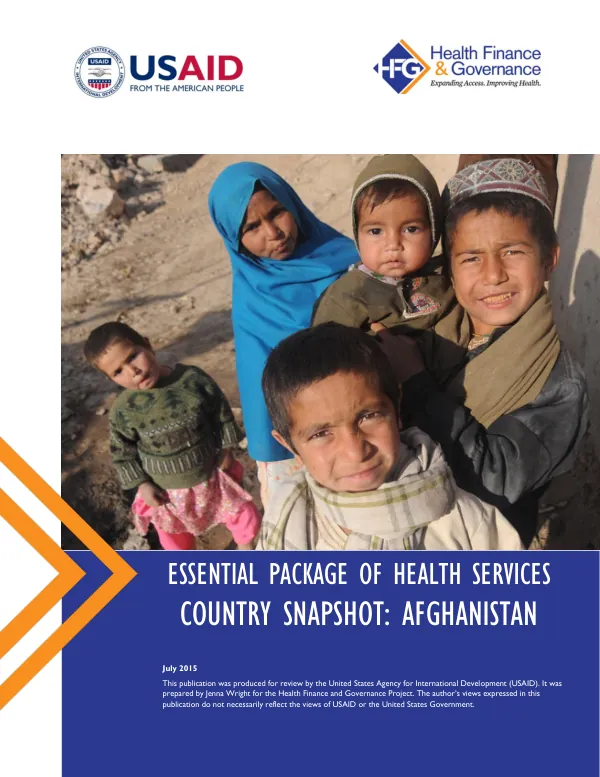
Essential Package of Health Services Country Snapshot: Afghanistan
The Essential Package of Health Services (EPHS) in Afghanistan is a clearly defined package of services that the government provides to its citizens in an equitable manner.
2015 · 44 pages
Sign in to readA free account is required to download.
Abstract
The EPHS includes a Basic Package of Health Services (BPHS) and an Essential Package of Hospital Services. The Ministry of Public Health first ratified the BPHS in March 2003, and revised it in 2005 and again in 2010. The purpose of the BPHS is to ensure that all primary health care facilities deliver a standardized package of basic services. The Essential Package of Hospital Services was published in 2005 to ensure that a standardized package of services was available at hospitals, and to promote a rational referral system in synergy with the BPHS. The EPHS in Afghanistan includes 38 services that are explicitly mentioned as included, 2 services that are explicitly excluded, 3 services that are implicitly excluded, and 17 services that are unspecified. The five priority reproductive, maternal, newborn, and child health (RMNCH) services that are excluded from Afghanistan's EPHS are safe abortion, social support during childbirth, home visits for women and children across the continuum of care, screen for and initiate or continue antiretroviral therapy for HIV, and routine immunization plus H. influenzae, meningococcal, pneumococcal, and rotavirus vaccines. The use of selected priority services in Afghanistan is presented in a table, which shows the country's data on common indicators such as pregnant women sleeping under insecticide-treated nets, births attended by skilled health personnel, BCG immunization coverage among one-year-olds, and Diphtheria tetanus toxoid and pertussis (DTP3) immunization coverage among one-year-olds. The health system in Afghanistan delivers RMNCH services through government-sponsored community health workers, public sector primary care facilities, and public sector referral facilities. The Basic Package of Health Services for Afghanistan—2010/1389 recognizes six classifications of facilities providing the BPHS across the country, including health posts, health sub-centers, basic health centers, mobile health teams, comprehensive health centers, and district hospitals. Community health workers staff each health post, and these facilities are intended to provide the basic package of health services and to provide referral services to district, provincial, and regional hospitals. The majority of these facilities are run by nongovernmental organizations and international donor partners, and the Ministry of Public Health has taken on a stewardship role over health care delivery, in which it manages the health system and provides oversight and guidance to the facilities. The country has few government-run facilities, and the health system relies heavily on external support and funding to deliver health services to the population.
Related documents