USAID DEC
Estimating the Impacts of Local Policy Innovation: The Synthetic Control Method Applied to Tropical Deforestation
Sign inNORTH CAROLINA A&T STATE UNIVERSITY
Estimating the Impacts of Local Policy Innovation: The Synthetic Control Method Applied to Tropical Deforestation
The Synthetic Control Method (SCM) is a quasi-experimental approach used to evaluate the impacts of conservation interventions by generating credible estimates of counterfactual baselines.
2015 · 15 pages
Sign in to readA free account is required to download.
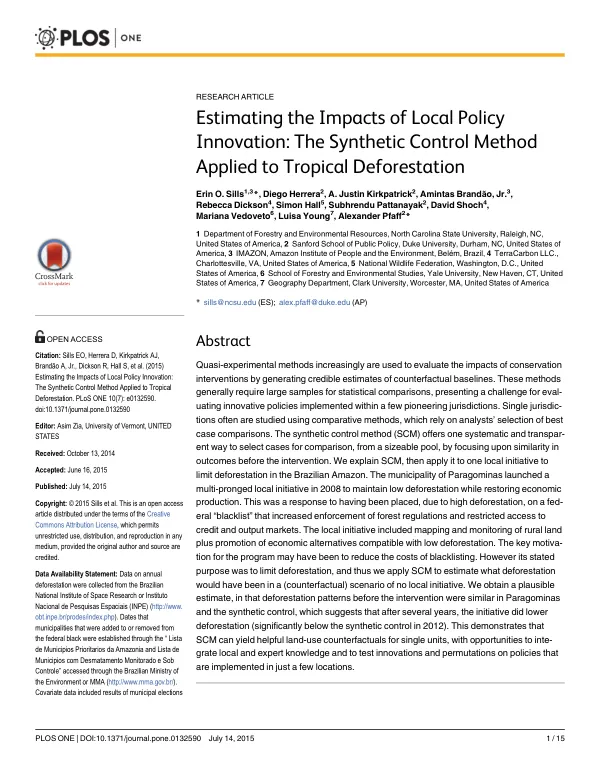
Abstract
This method is particularly useful for evaluating innovative policies implemented within a few pioneering jurisdictions, where large samples for statistical comparisons are not available. SCM offers a systematic and transparent way to select cases for comparison, focusing on similarity in outcomes before the intervention. The SCM was applied to a local initiative to limit deforestation in the Brazilian Amazon, specifically in the municipality of Paragominas. The initiative, launched in 2008, aimed to maintain low deforestation while restoring economic production. The municipality was placed on a federal "blacklist" due to high deforestation rates, which increased enforcement of forest regulations and restricted access to credit and output markets. The local initiative included mapping and monitoring of rural land, as well as promotion of economic alternatives compatible with low deforestation. The SCM estimates what deforestation would have been in a counterfactual scenario of no local initiative. The results show that deforestation patterns before the intervention were similar in Paragominas and the synthetic control, suggesting that the initiative did lower deforestation. In 2012, deforestation was significantly below the synthetic control, indicating a positive impact of the initiative. The SCM uses a weighted average of comparison units' outcomes to estimate the impact of the intervention. Weights are assigned to comparison units based on their similarity to the treated unit, both in terms of observed characteristics and historical outcomes. This approach allows for a more accurate estimation of the impact of the intervention, as it takes into account both observed and unobserved factors. The SCM has been applied to various contexts, including natural disasters, conflicts, and policy changes. While no method can completely eliminate the limitations imposed by a few treated sites and data points, SCM offers a systematic and transparent way to choose comparisons and estimate impacts. The use of pre-treatment outcomes in SCM can improve on typical matching of characteristics, as it reflects all influences on outcomes during the period in question. The SCM was applied to a dataset that included covariate data on municipal elections, results of municipal elections, and other variables such as protected areas, education, and foot and mouth disease. The data were collected from various sources, including the Brazilian National Institute of Space Research, the Brazilian Ministry of the Environment, and the United Nations Development Program. The study was funded by the American people through the United States Agency for International Development (USAID) and Duke University's Graduate School. The funders had no role in study design, data collection and analysis, decision to publish, or preparation of the manuscript. The authors declare no competing interests.
Related documents