DEVELOPMENT ALTERNATIVES, INC./FINNET
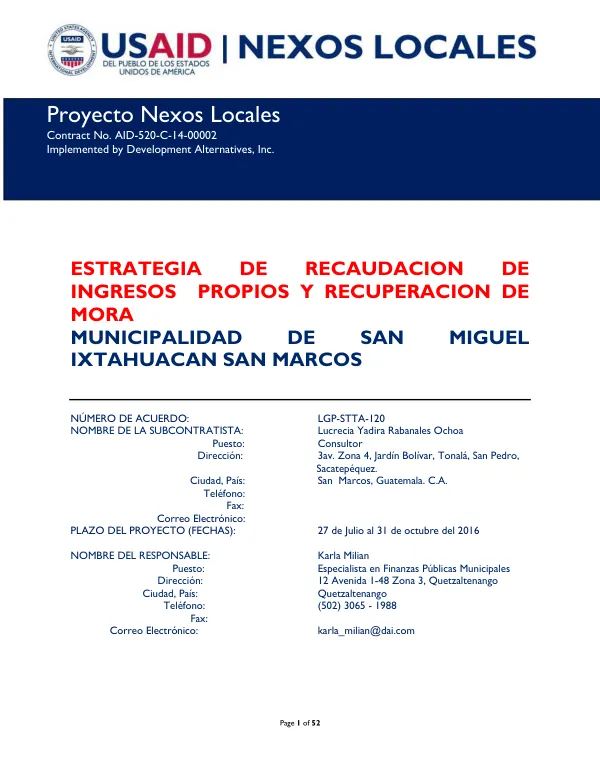
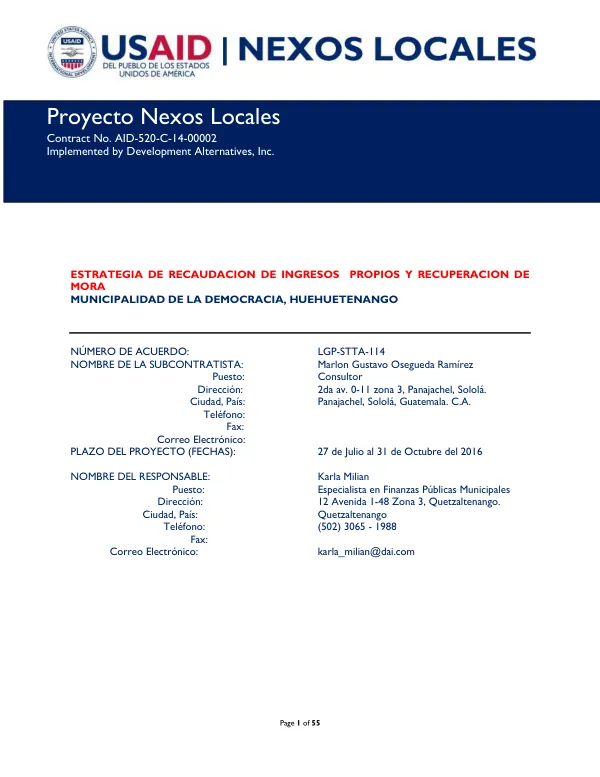
Estrategia de Recaudación de Ingresos Propios y Recuperación de Morosidad
The municipal government of La Democracia, Huehuetenango, in Guatemala, faces significant challenges in terms of low tax revenue, both at the central government and local levels.
2016 · 55 pages
Sign in to readA free account is required to download.
Abstract
To address this issue and provide a framework for improving the situation, the Nexos Locales project developed a technical assistance program for municipal financial management. This program presents an analysis of the main constitutional and ordinary laws that regulate the application of taxes and fees, as well as the data on income obtained by the municipality of La Democracia through the collection of taxes and fees. The results of the analysis confirm that the existing taxes are largely obsolete and uncollectible, dating back more than 13 years, and that there is no modern regulatory framework for determining, collecting, and updating taxes, which do not reflect the economic reality of the municipality of La Democracia. The technical assistance program was developed based on data obtained from fieldwork, which included financial information necessary to identify potential income for the year 2015, as well as indicators that reflect municipal work. The program identified the main sources of income for the municipality, including extractions of maize, piso de plaza, arrendamiento de locales, cementerio, valor boleto de ornato, feria titular, otros estacionamiento en vías públicas, canon de agua, servicio de limpieza, baños y sanitarios municipales, intereses generados por cuenta corriente, IUSI 2/1000, multa del boleto de ornato, otros ingresos, IUSI 9/1000, IUSI 6/1000, tiendas, and licencias. These sources of income represent 16% of the total income received by the municipality, with 7 being tributary, 3 non-tributary, 2 related to the sale of goods and services of the public administration, 5 operational, and 1 related to property rents. To address the challenges faced by the municipality, the Nexos Locales project, in conjunction with municipal officials, identified strategies for a good and healthy collection of municipal income, including: 1) political will, 2) compliance with the principle of legality, 3) technical capacity, 4) having updated and unified records of contributors, and 5) creating tax awareness in the population and/or accountability. The implementation of these strategies is essential to increase municipal income and reduce the need for borrowing to finance operational or investment expenses. The technical assistance program aims to contribute to the definition of the legal framework that regulates municipal income, establish simple concepts of taxes and fees, define who is responsible for creating or modifying them, and identify the principles or steps to be followed in the collection of municipal income. Additionally, the program aims to establish which administrative unit is responsible for directing the process of collecting municipal income and suggest actions to raise awareness among citizens of the importance of fulfilling their tax obligations towards the municipality.
Related documents