CHEMONICS
Estructura Ecológica Principal (EEP) para la jurisdicción de CARDIQUE
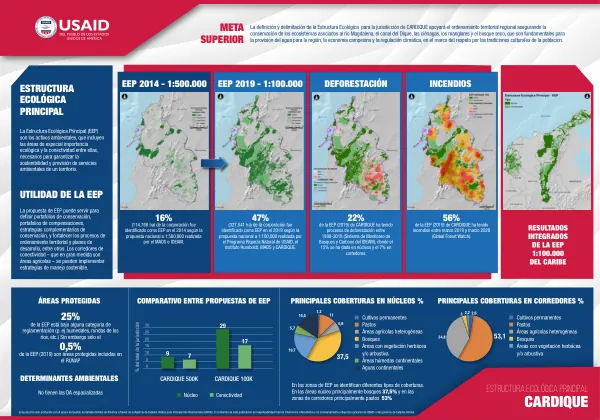
The Estructura Ecológica Principal (EEP) for the CARDIQUE jurisdiction aims to support regional territorial ordering, ensuring the conservation of ecosystems associated with the Magdalena River, the Dique Canal, ciénagas, mangroves, and the dry forest.
2020 · 1 pages
Sign in to readA free account is required to download.
Abstract
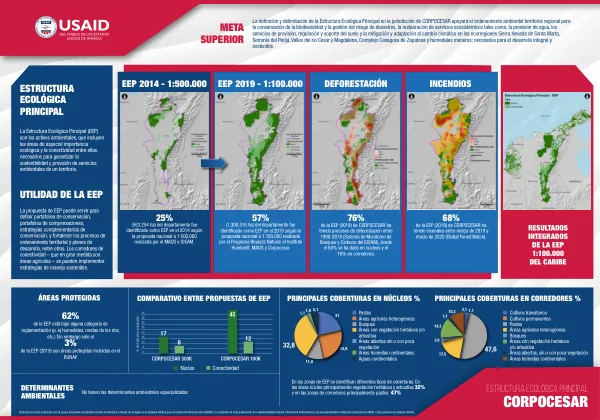
These ecosystems are crucial for water provision, rural economy, and climate regulation, while respecting the cultural traditions of the local population. The EEP is composed of key environmental assets, including areas of special ecological importance and connectivity between them, necessary to guarantee the sustainability and provision of environmental services in a territory. The proposed EEP can serve to define conservation portfolios, compensation portfolios, complementary conservation strategies, and strengthen territorial ordering and development planning processes. According to the 2019 proposal at a 1:100,000 scale, 47% (327,541 hectares) of the CARDIQUE corporation was identified as EEP. This area includes 56% of the EEP that experienced fires between March 2019 and March 2020, as reported by Global Forest Watch. Additionally, 22% of the EEP has undergone deforestation processes between 1990 and 2018, as monitored by the IDEAM's Forest and Carbon Monitoring System. The EEP also includes areas protected by regulations, such as wetlands and riverbanks, but only 0.5% of the EEP are areas protected under the RUNAP. The main coverages in the EEP núcleo are primarily forests (37.5%), while in the corredores, they are primarily pastures (53%).
Connected topics
Related documents