USAID DEC
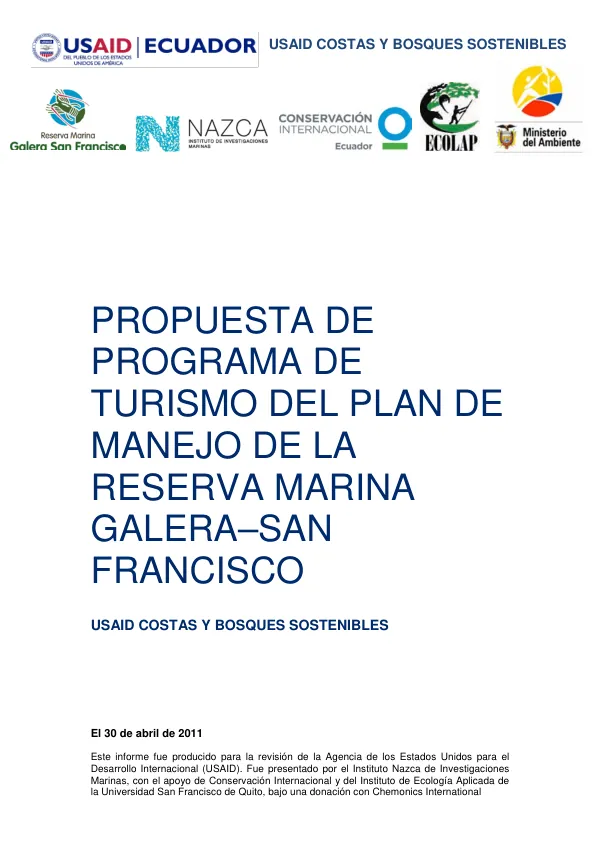
USAID COSTAS Y BOSQUES SOSTENIBLES: PROPUESTA DE PROGRAMA DE TURISMO DEL PLAN DE MANEJO DE LA RESERVA MARINA GALERA–SAN FRANCISCO
Sign inCHEMONICS
USAID COSTAS Y BOSQUES SOSTENIBLES: PROPUESTA DE PROGRAMA DE TURISMO DEL PLAN DE MANEJO DE LA RESERVA MARINA GALERA–SAN FRANCISCO
The Reserva Marina Galera-San Francisco (RMGSF) is a protected area of 54,604 hectares located on the southwestern coast of the province of Esmeraldas, within the jurisdiction of the cantón Muisne.
2011 · 19 pages
Sign in to readA free account is required to download.
Abstract
The area was created in 2008 through the signing of the Acuerdo Ministerial No. 162, which only included marine spaces. However, for the purpose of evaluating tourism in the RMGSF, it is necessary to consider the adjacent coastal zone where user populations and potential service providers reside. The RMGSF presents unique natural characteristics that harbor a significant display of marine biodiversity in Ecuador. This richness represents a significant potential in the tourism sector, which is increasingly in demand for destinations where the primary offer and attraction is the quality of environmental conditions and the richness of ecosystems present. In the framework of the Convenio de Cooperación for the support of the management of the Reserva Marina Galera-San Francisco between the Ministerio del Ambiente (MAE), the Corporación Instituto Nazca de Investigaciones Marinas, Conservation International Foundation Ecuador (CI-Ecuador), and The Nature Conservancy (TNC), this program is composed of several studies related to tourism in the RMGSF and its area of influence. These studies include a situational diagnosis, a characterization of tourist demand, an evaluation of tourist supply, a proposal for zoning the tourist space under the SIMAVIS methodology, and the objectives and activities proposed for the program within a logical framework matrix. The situational diagnosis addresses the environmental conditions of the RMGSF, describing the ecosystems of this area and the environmental problems existing due to the pressure of the medium on the resources present and the consequences of unplanned human actions. It also presents a general analysis of the socio-cultural and economic characteristics of the human settlements in the adjacent coastal area, emphasizing the relationship between the unsatisfied basic needs of the population and the environment. The legal framework in which tourism develops in a recognized protected area is analyzed, along with the role of the main institutions related to the development of the Programa de Turismo del Plan de Manejo de la RMGSF. The characterization of tourist demand was constructed through the investigation of secondary information sources and interviews with key actors, including a general description of the tourist market behavior related to the RMGSF. This analysis includes different scenarios that influence the area of interest, increasing its level of specificity during the development of the study. It describes the tourist market at the global, regional (in the Ecuadorian coast), provincial (in the province of Esmeraldas), and Patrimonio de Áreas Naturales del Estado (PANE) levels, and finally in the RMGSF. It also presents the three potential markets identified for the area of study, considering national visitors in the coastal zone of the Ecuadorian continental and national and foreign visitors to the PANE. The evaluation of the tourist supply of the RMGSF was developed participatively and mainly in the field, taking as a reference the methodology that considers tourism as a system. This study was developed based on the description of the elements that interact in this system: resources and potential tourist attractions of the area and its ecosystems, infrastructure, superstructure, plant, products, and tourist promotion. In the definition of the potential attractions, an inventory was raised, dividing it by its type into natural (marine and coastal) and cultural, which were georeferenced and presented in a map of the potential tourism of the RMGSF. As a final part of this section, a series of conclusions and recommendations for the tourist supply of the area were included. The proposal for tourist zoning presented was developed based on the SIMAVIS methodology applied to the RMGSF and its characteristics as an essentially marine space. It contains a description of the environments of each of the proposed areas and the use parameters according to the categorization assigned for management. Each zone has a map for its identification. Finally, the tourism program presents a logical framework matrix that exposes the objectives, results, and activities resulting from workshops with the Ministerio del Ambiente, other local and national authorities, and local residents, supported by the studies mentioned above. It also presents the budget by activity based on the type of resources needed (personnel, operational expenses, etc.).
Related documents
Documents in this collection
 2016
2016USAID DEC
Informe de Análisis de los Factores que Influyen en la Deforestación de la Provincia de Sucumbíos y su Proyección al 2030 y Recomendaciones para Afianzar los Procesos de Conservación o Frenar los Procesos de Deforestación
Open record 2014
2014USAID DEC