USAID DEC
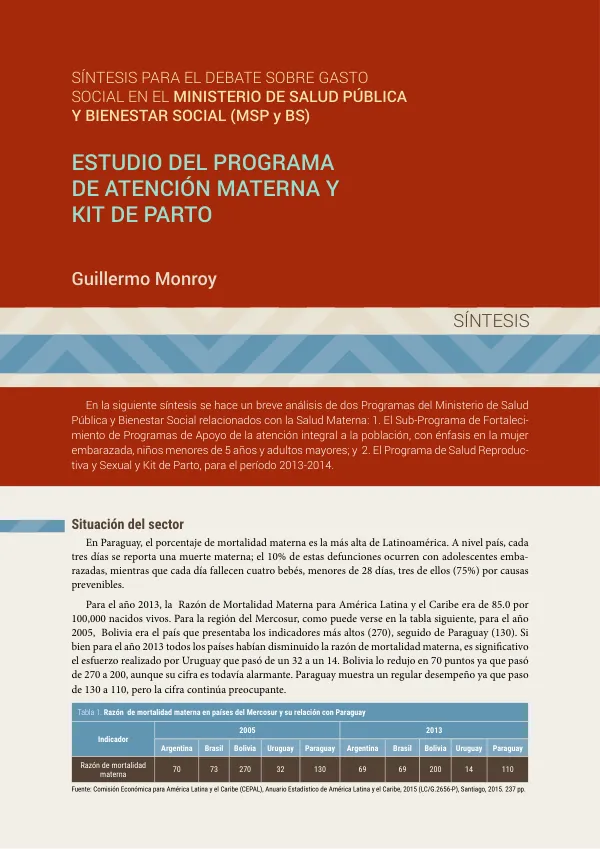
Estudio del Programa de Atención Materna y Kit de Parto
The Plan Nacional de Desarrollo (PND) for the period 2014-2030, established by the government of President Cartes, recognizes the high maternal mortality rate in Paraguay, which is more than double the average in the Cono Sur region.
2016 · 10 pages
Sign in to readA free account is required to download.
Abstract
The tasa de mortalidad infantil, or infant mortality rate, is also significantly higher than the regional average, with 17 deaths per 1,000 live births. The high disparities between regions make this rate 50% higher in disadvantaged areas. The Plan Nacional de Salud Sexual y Reproductiva 2014/2018, approved by Resolución Ministerial Nro. 340/2013, aims to improve the sexual and reproductive health of the Paraguayan population through the development of just, equitable, and integrative public policies, with a focus on gender, rights, and interculturalism. The plan proposes to reduce the maternal mortality rate and improve access to healthcare services for women, particularly in rural areas. The Ministry of Health and Social Welfare (MSPyBS) has implemented two programs related to maternal health: the Sub-Programa de Fortalecimiento de Programas de Apoyo de la atención integral a la población, with a focus on women, children under 5 years old, and adults over 60; and the Programa de Salud Reproductiva y Sexual y Kit de Parto, for the period 2013-2014. The programs aim to improve access to healthcare services, particularly for women in rural areas, and to reduce the maternal mortality rate. The Razón de Mortalidad Materna, or maternal mortality rate, in Paraguay is the highest in Latin America, with 100 deaths per 100,000 live births. The main causes of maternal mortality in the country are preventable, with abortion being the leading cause, followed by hemorrhages and toxemia. The Plan Nacional de Salud de Paraguay 2015-2030 recognizes that the maternal mortality rate has decreased between 2003 and 2011, but still remains high. The government has launched a Movilización Nacional por la Reducción de la Mortalidad Materna y Neonatal, or National Mobilization for the Reduction of Maternal and Neonatal Mortality, since 2010. In 2014, the country implemented the Código Rojo, a strategy that involves the entire healthcare system in responding to obstetric and neonatal emergencies. The Ministry of Health's budget has increased significantly since 2007, with a growth rate of 5.2% in relation to the country's GDP in 2007, and 12.2% in 2014. The budget for the Programa de Salud Reproductiva y Sexual y Kit de Parto has also increased, with a growth rate of 16.4% in 2013 and 81.6% in 2014. The program's budget for 2014 was Gs. 3,449,020,968,231, which represents 13.5% of the Ministry's total budget. The government has allocated significant resources to the Programa de Salud Reproductiva y Sexual y Kit de Parto, with a budget of Gs. 4,500,049,796,127 in 2014, which represents 76.6% of the program's total budget. The program's budget for 2013 was Gs. 4,049,464,064,580, which represents 70.3% of the program's total budget. The program's budget for 2014 was also allocated to various categories, including services personnel, non-personnel services, goods and services, and investment in physical infrastructure.