WORLD HEALTH ORGANIZATION
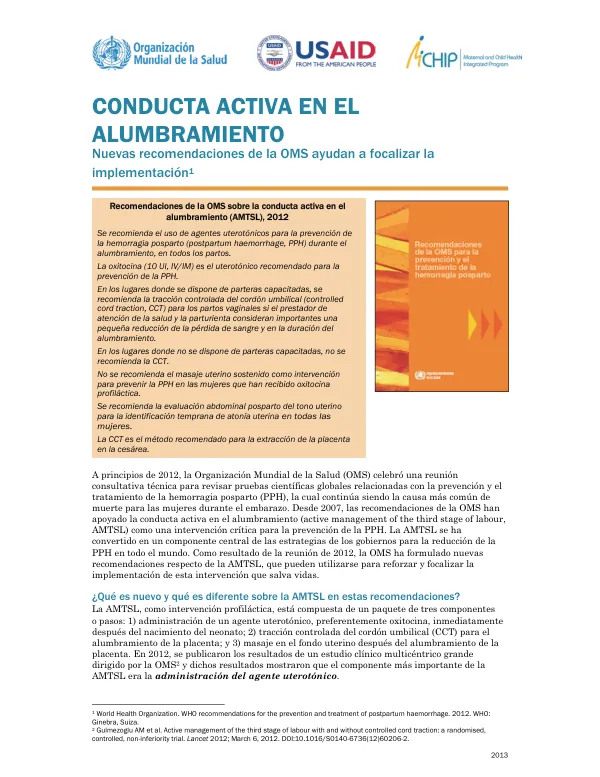
Recomendaciones de la OMS sobre la conducta activa en el alumbramiento (AMTSL)
The World Health Organization (WHO) has issued new recommendations for the active management of the third stage of labor (AMTSL) to help reduce postpartum hemorrhage (PPH), a leading cause of maternal mortality worldwide.
2012 · 3 pages
Sign in to readA free account is required to download.
Abstract
The AMTSL is a critical intervention for preventing PPH, and its implementation has been a key strategy for governments to reduce PPH globally. The AMTSL is a package of three components or steps: 1) administration of a uterotonic agent, preferably oxytocin, immediately after the birth of the neonate; 2) controlled cord traction (CCT) for the delivery of the placenta; and 3) uterine massage after the delivery of the placenta. A large clinical trial conducted by the WHO in 2012 showed that the administration of a uterotonic agent was the most important component of the AMTSL in preventing PPH. However, the study also found that the addition of CCT had a minimal effect on reducing hemorrhage, with women who received CCT bleeding an average of 10 ml less than those who expelled the placenta on their own. Nevertheless, there was a real difference in the duration of the third stage of labor, with women who did not receive CCT experiencing a six-minute longer delivery time. This may be significant for the management of labor in busy delivery rooms or for individual providers. Based on these findings and existing scientific evidence on the function of routine uterine massage in preventing PPH, the WHO has formulated new recommendations clarifying that, while the administration of a uterotonic agent remains central to the AMTSL, the performance of CCT and immediate uterine massage are optional components. The new recommendations do not suggest a change in the way providers are trained in the AMTSL or in the implementation of the AMTSL in healthcare facilities. Instead, they emphasize the importance of ensuring that all women receive a uterotonic agent immediately after delivery, regardless of the location of the birth. This can be achieved by promoting the AMTSL in healthcare facilities and developing community-based programs for the use of misoprostol in women whose births occur at home. A new approach to preventing PPH through the AMTSL involves ensuring that all women receive a uterotonic agent immediately after the birth of the neonate, delaying cord clamping for at least 1-3 minutes to reduce anemia in the newborn, and performing CCT if necessary. Postpartum surveillance involves evaluating the uterine tone immediately after delivery to ensure a contracted uterus, continuing to monitor it every 15 minutes for 2 hours, and performing uterine massage and more frequent monitoring if atony is detected. Ensuring the continuous supply of high-quality oxytocin is also crucial, with proper storage and handling to prevent degradation of the medication. The WHO's new recommendations highlight the importance of ensuring that all women receive a uterotonic agent immediately after delivery, regardless of the location of the birth, to prevent PPH. This emphasis can increase coverage and improve quality, allowing program managers and supervisors to focus on the most effective components of the package of care.
Related documents