ENCOMPASS, LLC
Estudio Sobre la Participación y el Compromiso Cívico de la Juventud Peruana
The youth participation and civic engagement in Peru is a pressing issue that requires attention in the public agenda.
2022 · 2 pages
Sign in to readA free account is required to download.
Abstract
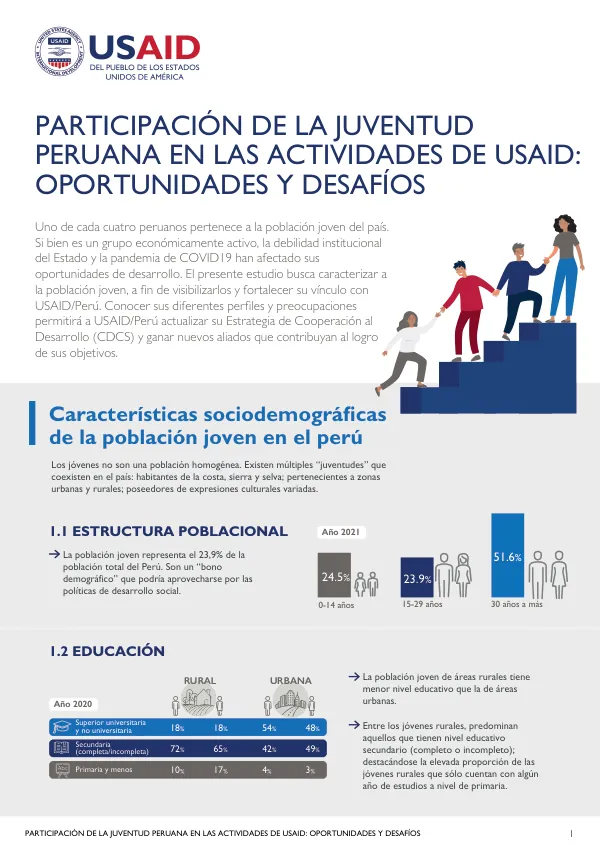
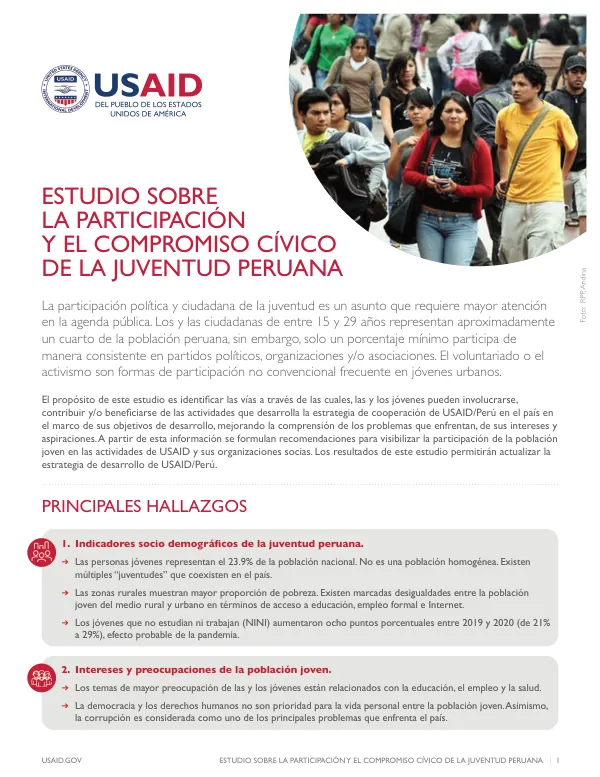
Approximately one-quarter of the Peruvian population consists of individuals between the ages of 15 and 29, yet only a small percentage participates consistently in political parties, organizations, and associations. Non-conventional forms of participation, such as volunteering or activism, are common among young urban residents. The purpose of this study is to identify the pathways through which young people can become involved, contribute to, and benefit from the activities of USAID/Peru's cooperation strategy in the country, in line with its development objectives. This study aims to improve the understanding of the problems faced by young people, their interests, and aspirations. Based on this information, recommendations are formulated to highlight the participation of young people in USAID's activities and those of its partner organizations. The results of this study will enable the updating of USAID/Peru's development strategy. The study reveals that the youth population in Peru is not homogeneous, with multiple "youths" coexisting in the country. Rural areas show a higher proportion of poverty, with marked inequalities between young people from rural and urban areas in terms of access to education, formal employment, and the internet. The number of young people who do not study or work (NINI) increased by eight percentage points between 2019 and 2020, likely due to the pandemic. The study also identifies the interests and concerns of the young population, with education, employment, and health being the most pressing issues. Democracy and human rights are not a priority for young people's personal lives, and corruption is considered one of the main problems facing the country. The study highlights the lack of incentives for young people to participate in politics in a permanent manner, with participation in public mobilizations on specific issues being more common. Young people living in urban areas and those with higher levels of education demonstrate a greater interest in political participation. In rural areas, political participation by young people in national mobilizations has been minor. The study also notes that young people's participation in civic activities is limited, but volunteering is a common practice, especially among urban youth, to support vulnerable groups. With the onset of the pandemic, virtual volunteering has increased significantly. For urban youth, virtual interest groups have become a significant form of organization, especially among those with higher education and concern for the country. Social media has become an important channel of communication and mobilization. Based on the findings, the study recommends incorporating youth and life cycle approaches into USAID's cooperation strategy for Peru's development, allowing for the comprehensive addressing of different stages of youth development. The study also recommends identifying community-led initiatives led by young people to incorporate these experiences into ongoing or planned activities. Additionally, activities specifically targeting young people who do not study or work (NINI) are recommended, as well as incorporating communication components that differentiate the target audience by sex and age.