BANK FOR WEST AFRICAN DEVELOPMENT
ETOP UPDATE JULY 2011
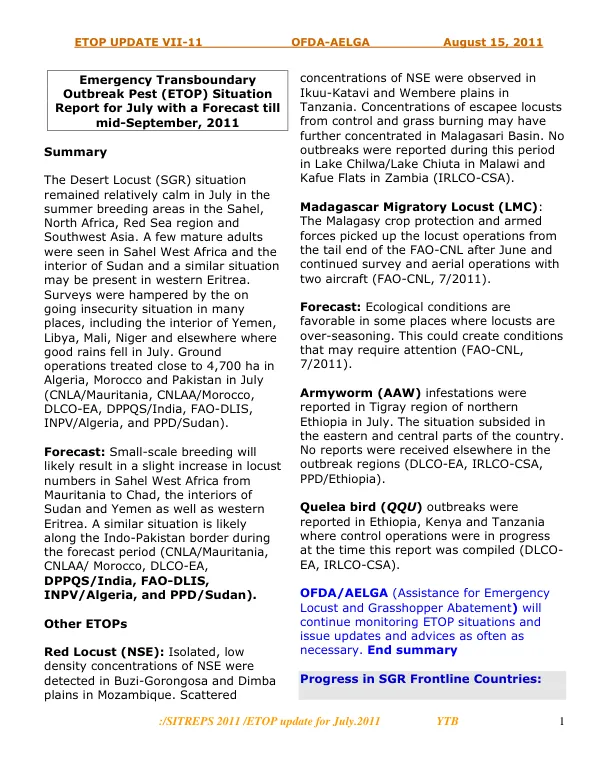
The Desert Locust (SGR) situation in July 2011 remained relatively calm in the summer breeding areas in the Sahel, North Africa, Red Sea region, and Southwest Asia.
2011 · 8 pages
Sign in to readA free account is required to download.
Abstract
A few mature adults were seen in Sahel West Africa and the interior of Sudan, and a similar situation may be present in western Eritrea. Surveys were hampered by the ongoing insecurity situation in many places, including the interior of Yemen, Libya, Mali, Niger, and elsewhere where good rains fell in July. Ground operations treated close to 4,700 hectares in Algeria, Morocco, and Pakistan in July. The forecast for the period from mid-July to mid-September 2011 indicates that small-scale breeding will likely result in a slight increase in locust numbers in Sahel West Africa from Mauritania to Chad, the interiors of Sudan and Yemen, as well as western Eritrea. A similar situation is likely along the Indo-Pakistan border during the forecast period. Red Locust (NSE) infestations were reported in Buzi-Gorongosa and Dimba plains in Mozambique, Ikuu-Katavi and Wembere plains in Tanzania, and Malagasari Basin. No outbreaks were reported in Lake Chilwa/Lake Chiuta in Malawi and Kafue Flats in Zambia. The Malagasy crop protection and armed forces continued survey and aerial operations with two aircraft. Ecological conditions are favorable in some places where locusts are over-seasoning, which could create conditions that may require attention. Armyworm (AAW) infestations were reported in Tigray region of northern Ethiopia in July, but the situation subsided in the eastern and central parts of the country. No reports were received elsewhere in the outbreak regions. Quelea bird (QQU) outbreaks were reported in Ethiopia, Kenya, and Tanzania, where control operations were in progress at the time this report was compiled. The Inter-Tropical Front (ITF) remained relatively stationary in July 2011, but a major proportion of the ITF coincided with the climatological mean position during this time of the year. However, the western segment lagged behind the average position partly due to an anomalous cyclonic circulation located in North Africa and the northeasterly components it blocked the advancement of the ITF during the third dekad of July. The mean western portion of the ITF was approximately located at 18.5N trailing the climatological mean by 0.8 degrees. Dry conditions prevailed in most of the IRLCO-CSA countries during July, and only light showers were reported in some parts of central Mozambique, eastern Zimbabwe, and Malawi. NSE outbreaks in parts of Zambia, Zimbabwe, Mozambique, Malawi, and Tanzania remained cool and dry. Due to prevailing dry conditions, vegetation burning intensified in most of the NSE outbreak areas, forcing locusts to concentrate in unburned patches of green vegetation. Control operations treated locally bred hopper and adult groups in Western Sahara, central Algeria, and northeast Morocco in July. Low numbers of solitary adults started appearing in the summer breeding areas of northern Sahel, in southern and central Mauritania, and northern Niger. A similar situation may be present in northern Mali and parts of eastern Chad. Survey operations were hampered by the ongoing insecurity situation in other countries. The forecast for the period from mid-July to mid-September 2011 indicates that adult locusts from North Africa will likely move to the summer breeding areas in northern Sahel and begin breeding during the forecast period. This will slightly increase locust numbers in a few places in Sahel West Africa during the forecast period. Scattered adult locusts were detected in the summer breeding areas, and some scattered solitary adults were detected in the interior of Sudan, western lowlands in Eritrea, and in the interior of Yemen north of Wadi Hadramaut.
Related documents