AGENCIA DE LOS ESTADOS UNIDOS PARA EL DESARROLLO INTERNACIONAL
Evaluación del Enfoque Diferencial de la ACR para Personas con Discapacidad
The Colombian Agency for Reintegration (ACR) has been working on the inclusion of differential approaches since 2010, with the implementation of the Psychosocial Attention Model for Peace (MAPAZ).
2016 · 3 pages
Sign in to readA free account is required to download.
Abstract
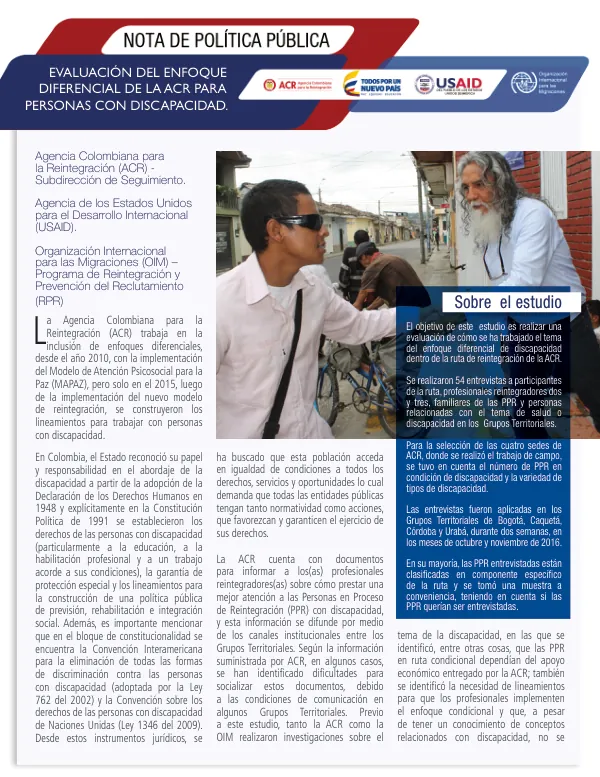
However, it was not until 2015, after the implementation of the new reintegration model, that guidelines were established for working with people with disabilities. In Colombia, the state recognized its role and responsibility in addressing disability since the adoption of the Declaration of Human Rights in 1948 and explicitly in the 1991 Constitution, which established the rights of people with disabilities, particularly education, professional habilitation, and employment according to their conditions. The ACR has documents to inform professionals about how to provide better attention to People in the Process of Reintegration (PPR) with disabilities, and this information is disseminated through institutional channels to the Territorial Groups. According to the information provided by ACR, in some cases, difficulties have been identified in socializing these documents due to communication conditions in some Territorial Groups. Prior to this study, both ACR and OIM conducted research on the topic of disability, which identified, among other things, that PPR in conditional route depended on economic support provided by ACR, and the need for guidelines for professionals to implement the conditional approach. The objective of this study is to evaluate how the differential approach to disability has been worked on within the ACR's reintegration route. Fifty-four interviews were conducted with participants from the route, professionals, family members of PPR, and people related to health or disability in the Territorial Groups. The selection of the four ACR offices where the fieldwork was conducted took into account the number of PPR with disabilities and the variety of types of disabilities. The interviews were applied in the Territorial Groups of Bogotá, Caquetá, Córdoba, and Urabá, during two weeks in October and November 2016. Most of the PPR interviewed are classified in the specific component of the route, and a convenience sample was taken, taking into account whether the PPR wanted to be interviewed. The evaluation of the ACR's differential approach for people with disabilities reveals the application of the same in the route. Based on these findings, during 2016, ACR modified Resolution 0754 of 2013 to strengthen the accompaniment provided to people with disabilities and other populations that have been focused on receiving a specific psychosocial accompaniment for their characteristics (older people and people with high-cost diseases). These changes, contained in Resolution 1356 of 2016, emphasize the importance of concerting work plans that respond to the needs of PPR and their family groups. Additionally, the economic support time was extended to strengthen the capacities and social and institutional support networks of this population and their family groups. To develop the research, a qualitative analysis of the interviews conducted in the field was carried out, in light of five categories: (1) Characterization of PPR with disabilities, (2) Perceptions of their disability, (3) ACR's work plan, (4) Institutional offer in the region, and (5) Knowledge of PPR's rights with disabilities. A synthesis of the findings in each of the categories is presented below. In the Territorial Groups visited, PPR with disabilities live with limited resources, most of them accompanied by a family member, except in the department of Caquetá, where professionals have become the primary support network due to the absence of family members and the difficulty of PPR in establishing relationships with other people. In terms of employment, most of those with autonomy in their mobility manage to obtain resources from informal activities, and in one case, formal employment was found. Despite this, in the interviews conducted, it was agreed that most of them depend on the economic support provided by ACR. All PPR are affiliated with the health system, mostly subsidized EPS, although some of them do not receive specific treatments or therapies for their health condition, despite needing them. PPR coincide in that their disability prevents them from continuing their studies or finding formal employment, generating feelings of frustration, especially in front of the limitations that their disability has generated in their daily life. Some PPR also reported feeling social rejection due to being demobilized. This feeling predominates, especially in the city of Bogotá and in the department of Montería. For example, in the municipality of Tierra Alta, they reported that they have been denied the provision of health services. This shows that, in some cases, PPR are in a condition of triple vulnerability due to their disability, their condition as "demobilized," and their economic condition. The family members of PPR with limited mobility hold the hope that these people can overcome their disability and improve their quality of life. These aspirations are shared by PPR with greater autonomy, who hope to have the possibility of finding treatments that will allow them to improve their physical or mental condition. The professionals reintegrators generally design the work plan in a concerted manner with the
Related documents