USAID. BUR. FOR FOOD FOR PEACE AND VOLUNTARY ASSISTANCE. OFC. OF PROGRAM POLICY AND MANAGEMENT
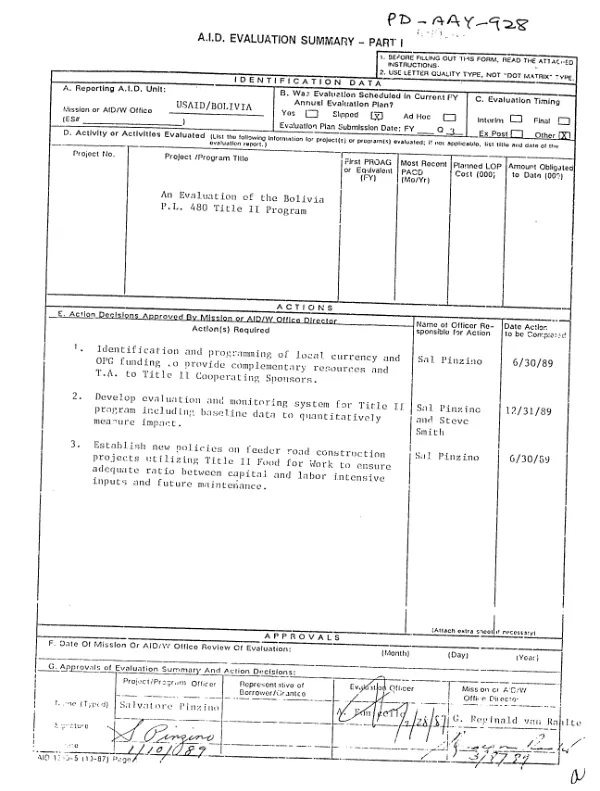
Evaluation of the Bolivia PL-480 Title II program
Summarizes attached evaluation (XD-AAY-928-A) of a P.L.
1989
Sign in to readA free account is required to download.
Abstract
480 Title II Food for Work (FFW) program in Bolivia implemented in response to the 1983-84 El Nino drought. External evaluation covers the period 1983-11/88. FFW is a highly visible, much needed program that creates 44,000 jobs per month, and contributes very positively to Bolivia"s infrastructural and agricultural development. The program provides $9.6 million in food annually through four cooperating sponsors: CRS/Caritas; the Adventist Relief and Development Agency (ADRA); Food for the Hungry, International; and the Bolivian National Community Development Service. FFW"s urban development component has been an unqualified success. In addition to creating employment for thousands of unemployed people, it has significantly contributed to infrastructure development in marginal urban areas. The program"s road component differs markedly in urban and rural areas. Urban road construction activities are successful in generating employment, but production is less efficient than that of private contractors. This is largely due to lack of trained labor, labor-intensive management methods, and adequate tools. Rural road activities are less successful in generating employment, especially in the case of large mountain roads, where heavy equipment accounts for 70% of costs. Maintenance is also a problem in these sparsely populated areas. Under the rural development component, coordinating sponsors have improved project planning and are gradually moving away from emergency assistance and toward an integrated development approach. Through FFW, food production and livestock projects have penetrated poor areas without prior access to extension services. On the other hand, the rural programs - especially those of CRS/Caritas and ADRA - suffer from lack of focus. Sponsors need to limit the number, types, and geographic area of their activities. Sponsors should also generate funds through the monetization of P.L. 480 commodities to meet the costs of needed planning, monitoring, and evaluation systems. Implementation of an independent quantitative study of the FFW projects" development impact is also recommended. Several lessons were learned. (1) Provision of management TA and complementary resources from P.L. 480 Title I and III local currency generations are essential to FFW success. (2) Monetization of P.L. 480 Title II commodities can provide needed resources for strengthening project management. (3) Rural programs are more effective when sponsors target the poorest geographic areas and address perceived local needs.
Related documents