USAID DEC
Evaluation of the Parenting Education program pilot with agricultural associations in Mozambique
Sign inPATH
Evaluation of the Parenting Education program pilot with agricultural associations in Mozambique
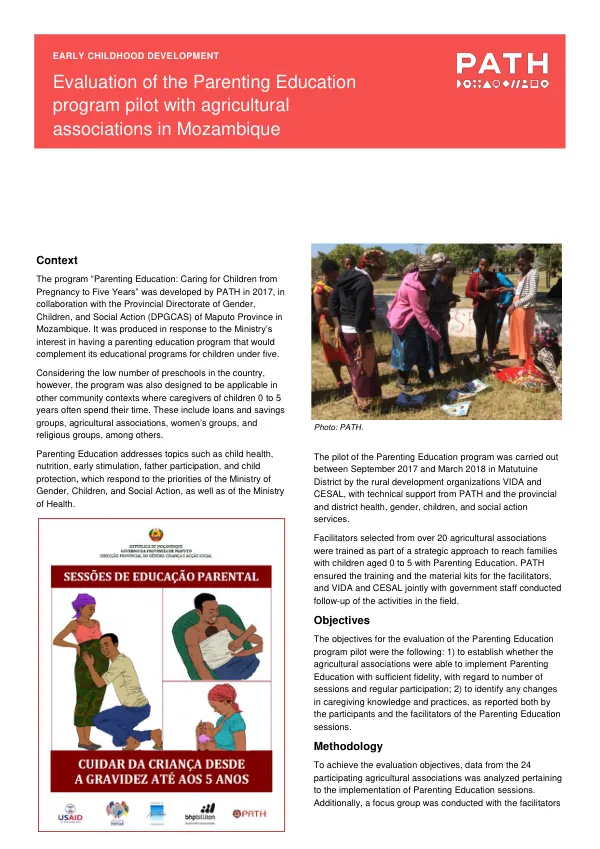
The Parenting Education program was developed by PATH in 2017 in collaboration with the Provincial Directorate of Gender, Children, and Social Action (DPGCAS) of Maputo Province in Mozambique.
2018 · 2 pages
Sign in to readA free account is required to download.
Abstract
The program was designed to complement the Ministry's educational programs for children under five, considering the low number of preschools in the country. Parenting Education addresses topics such as child health, nutrition, early stimulation, father participation, and child protection, which respond to the priorities of the Ministry of Gender, Children, and Social Action, as well as of the Ministry of Health. The pilot of the Parenting Education program was carried out between September 2017 and March 2018 in Matutuine District by the rural development organizations VIDA and CESAL, with technical support from PATH and the provincial and district health, gender, children, and social action services. Facilitators selected from over 20 agricultural associations were trained as part of a strategic approach to reach families with children aged 0 to 5 with Parenting Education. PATH ensured the training and the material kits for the facilitators, and VIDA and CESAL jointly with government staff conducted follow-up of the activities in the field. The objectives for the evaluation of the Parenting Education program pilot were to establish whether the agricultural associations were able to implement Parenting Education with sufficient fidelity, with regard to number of sessions and regular participation, and to identify any changes in caregiving knowledge and practices, as reported both by the participants and the facilitators of the Parenting Education sessions. To achieve the evaluation objectives, data from the 24 participating agricultural associations was analyzed pertaining to the implementation of Parenting Education sessions. Additionally, a focus group was conducted with the facilitators from ten associations, and four agricultural associations that implemented Parenting Education most regularly were purposefully selected to participate in the focus groups and interviews on changes in caregiver knowledge and practices. The results of the evaluation indicate that the program was efficient in mobilizing and retaining participants. Out of the 24 associations, 22 carried out sessions on a regular basis, with most associations conducting 6 or more sessions out of total 10 topic areas, and 15 associations maintained adequate records. The associations did not limit themselves to conducting sessions with its members but brought the program to community meetings, churches, and savings groups. The evidence regarding changes in caregiver knowledge and practices suggests that the project stimulated behavior and attitude change, both in facilitators and participants, in three main areas: family nutritional practices, especially child feeding; gender dynamics; and caregiver-child interactions. The participants highlighted greater use of local products, varying the foods given to the child, and giving children fewer unhealthy snacks. As a result of the Parenting Education sessions, the participants observed changes in gender dynamics in their household, including increased participation of men in household chores and in child caregiving, as well as improved communication in the families. The participants also stressed the positive behavior change when interacting with their children, giving more time to playing and talking with their children during daily routines and to making toys, and reducing the use of violent methods in correcting children's behavior.
Related documents
Documents in this collection
 2018
2018USAID DEC
Quarterly Report: Q2 July–September 2018 for Integrating Early Childhood Development (ECD) Global Development Alliance (GDA) Programming
Open record 2019
2019USAID DEC
MCSP Nutrition Brief: Key Country Experiences in Addressing Junk Food Consumption in Maternal, Infant, and Young Child Nutrition Programming
Open record