MINISTRY OF HEALTH
Promoting Maternal Mental Health within Routine Health Services
Maternal mental health is a critical aspect of routine health services, particularly in the postnatal period.
2019 · 2 pages
Sign in to readA free account is required to download.
Abstract
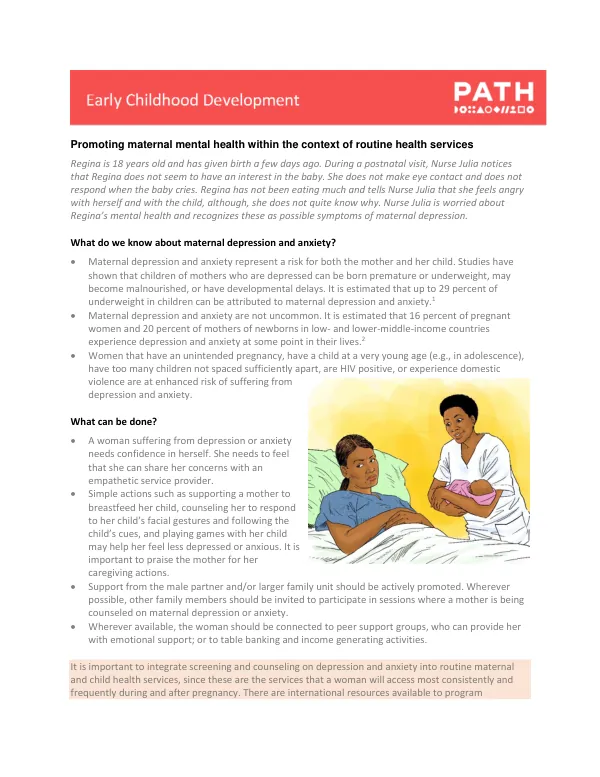
A mother's mental well-being has a direct impact on her child's development and overall health. Studies have shown that children born to mothers with depression and anxiety are at a higher risk of being premature or underweight, experiencing malnutrition, or having developmental delays. In fact, up to 29 percent of underweight in children can be attributed to maternal depression and anxiety. Maternal depression and anxiety are not uncommon, affecting an estimated 16 percent of pregnant women and 20 percent of mothers of newborns in low- and lower-middle-income countries. Various factors can increase a woman's risk of suffering from depression and anxiety, including unintended pregnancy, having a child at a young age, having multiple children with insufficient spacing, being HIV positive, or experiencing domestic violence. Early identification and intervention are crucial in addressing maternal depression and anxiety. A supportive service provider can play a vital role in helping a mother feel confident and empowered to share her concerns. Simple actions such as supporting breastfeeding, counseling on responding to a child's facial gestures, and engaging in play with the child can help alleviate symptoms of depression and anxiety. Praise and recognition of a mother's caregiving actions can also have a positive impact. Involving the male partner and larger family unit in the support process is essential. Where possible, other family members should be encouraged to participate in counseling sessions. Connecting a woman to peer support groups or income-generating activities can also provide emotional support and help alleviate symptoms of depression and anxiety. Integrating screening and counseling on depression and anxiety into routine maternal and child health services is critical. This can be achieved through the use of international resources such as the World Health Organization's Thinking Healthy manual. In Mozambique, PATH has partnered with the Ministry of Health to develop and pilot a package of screening, counseling, and referral interventions based on Thinking Healthy. This package will be implemented in postnatal consultations by maternal and child health nurses in selected health facilities of Maputo Province. Research has shown that maternal depression and anxiety can have a significant impact on a child's growth and development. Studies have found that children of mothers with depression and anxiety are at a higher risk of being underweight, experiencing malnutrition, or having developmental delays. In fact, up to 29 percent of underweight in children can be attributed to maternal depression and anxiety. The World Health Organization's Thinking Healthy manual provides a comprehensive guide for psychosocial management of perinatal depression. The manual emphasizes the importance of early identification and intervention, as well as the need for a supportive service provider. Simple actions such as supporting breastfeeding, counseling on responding to a child's facial gestures, and engaging in play with the child can help alleviate symptoms of depression and anxiety. The impact of maternal depression and anxiety on a child's growth and development cannot be overstated. Research has shown that children of mothers with depression and anxiety are at a higher risk of being underweight, experiencing malnutrition, or having developmental delays. In fact, up to 29 percent of underweight in children can be attributed to maternal depression and anxiety.
Related documents