ABT ASSOCIATES, INC.
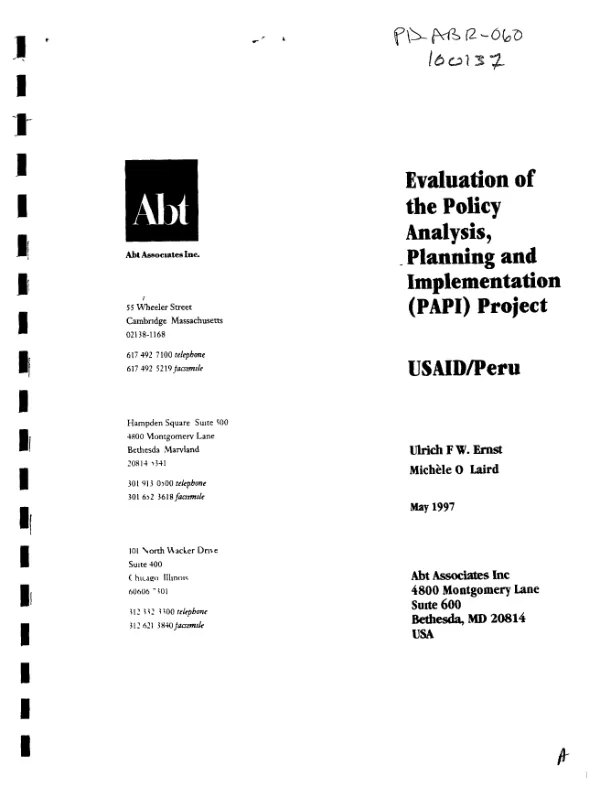
Evaluation of the policy analysis, planning and implementation (PAPI) project
Evaluates project (9/90-3/95) to provide policy analysis, planning, and implementation assistance in support of economic reform in Peru (PAPI project).
Ernst, Ulrich F. W.|Laird, Michele O. · 1997
Sign in to readA free account is required to download.
Abstract
Final evaluation covers the period 9/90-5/97 against a PACD of 6/97 or, more likely, 12/97. The project has contributed appreciably to the design and implementation of policy reform, not only enabling Government of Peru (GOP) entities to address needs difficult to deal with under other funding vehicles, but also offering a flexible and quick-response mechanism for responding to these needs. On the other hand, project activities, while technically sound, have not been sufficiently integrated into the policy priorities either of the USAID Mission or the GOP; no clear strategic framework or specific criteria guide the selection of activities to be funded. In fact, the management of project funds as a semiannual "sweepstakes" or competition has severely impaired the ability to use project support in a programmatic fashion (e.g., by combining research, training, consensus-building, and dissemination). The result has been a fairly large number of (mostly) useful activities lacking a coherent thrust that would optimize policy impact; attainment of end of project (EOPS) targets, as outlined in amendment no. 5 to the ProAg, has been uneven. Also, even after the attempts at streamlining under amendment no. 5, the project structure is complex and confusing for the executing agencies. Poor communication between members of the PAPI team has reduced the project's efficacy and resulted in poor morale. USAID contributed to the confusion by issuing a project implementation letter that significantly realigned responsibilities, but did not modify the TA contract accordingly. As a result, for almost 2 years, two distinct project entities -- the Technical Unit and the institutional contractor -- could claim a USAID mandate for taking the lead on technical issues. Lessons learned are as follows: (1) A project providing a flexible, quick-response mechanism to allow government agencies to address emerging policy reform issues is a valuable element of development assistance. Properly used, such a project can advance USAID/Peru's strategic objectives (SOs) by focusing on cross-cutting themes and areas of common priorities. (2) This type of project places a premium on strategic management procedures in order to ensure a common understanding of priorities and procedures among all participants. Since policy priorities change over time, especially in a period of rapid transition, such a project needs a built-in capability to review specific objectives and areas of concentration. Without this capability, objectives once appropriate may no longer apply, allowing for a softening of the project focus and the possible inclusion of activities that do not reflect current policy priorities. (3) To realize the policy dialogue potential of a project like this, USAID/Peru must maintain direct control over the structure that gives the project substantive direction. A "hands-off" approach entails the risk of spending resources on activities that relate only marginally to the Mission strategy. Relying primarily on USAID-funded counterparts for strategic leadership complicates matters, because that group is neither fully part of the GOP structure nor subject to USAID oversight. The project management structure that has emerged under PAPI has proven ineffective for promoting USAID/Peru-GOP policy dialogue. (4) If a "ronda" system is used in this type of project (that is, if activities are selected from requests after solicitation), proactive outreach is required to encourage submissions that reflect policy priorities and to make certain that potential applicants clearly understand these priorities and related selection criteria. Also needed is a mechanism to allow for more programmatic support (follow-up or the combination of research, training, consensus-building, and dissemination). (5) Technical and administrative guidance, as well as monitoring, should be simple and straightforward so as to reduce costs and confusion and facilitate better internal communications and closer Mission monitoring. (6) In the Peruvian context, funding public and private sector activities under one ProAg while separating the entities supervising the activities can create friction and hamper rather than promote constructive policy dialogue, though less so if both technical direction and administration are more closely controlled by USAID/Peru itself.
![Evaluation of USAID/Peru strategic objective 4 program and framework [: sustainable environment and natural resources management]](https://covers.devme.ai/gen/14261.webp)
![Project assistance completion report : economic policy research project - INCAE [Central American Institute of Business Administration] component](https://covers.devme.ai/gen/7659.webp)
![Project assistance completion report : economic policy research project - INCAE [Central American Institute of Business Administration] component](https://covers.devme.ai/gen/38222.webp)
![Evaluation of USAID/Peru strategic objective 4 program and framework [: sustainable environment and natural resources management]](https://covers.devme.ai/gen/5493.webp)