USAID DEC
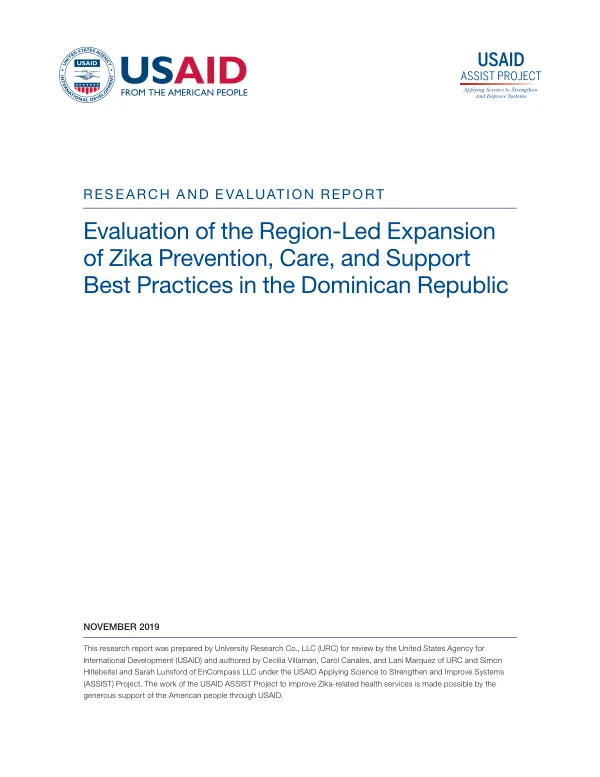
Evaluation of the Region-Led Expansion of Zika Prevention, Care, and Support Best Practices in the Dominican Republic
Sign inENCOMPASS, LLC
Evaluation of the Region-Led Expansion of Zika Prevention, Care, and Support Best Practices in the Dominican Republic
The Dominican Republic's Ministry of Health, in collaboration with the USAID Applying Science to Strengthen and Improve Systems (ASSIST) Project, implemented a scale-up of Zika prevention, care, and support best practices in 2019.
2019 · 24 pages
Sign in to readA free account is required to download.
Abstract
The scale-up aimed to improve the quality of Zika services, specifically prenatal care, newborn screening, and care and support for babies and families affected by Zika. The project targeted four health regions in the country, providing light technical support to facilitate the adoption of best practices. The scale-up process involved the implementation of several key activities, including the provision of training and technical assistance to healthcare providers, the establishment of quality improvement teams, and the development of guidelines and protocols for Zika care. The project also facilitated the sharing of best practices and experiences among healthcare providers and regional health authorities. The evaluation of the scale-up process found that the regions that participated in the first wave of the project showed significant improvements in the quality of Zika care, including a 25% increase in the percentage of newborns properly evaluated for microcephaly. The regions that did not participate in the first wave also showed improvements, although to a lesser extent. The evaluation also found that the implementation of best practices was facilitated by the provision of technical support and the establishment of quality improvement teams. The evaluation team conducted qualitative interviews with key actors in the scale-up process, including healthcare providers, regional health authorities, and project staff. The interviews revealed that the scale-up process was facilitated by the provision of technical support, the establishment of quality improvement teams, and the development of guidelines and protocols for Zika care. However, the interviews also identified several challenges, including the lack of resources and infrastructure, the need for further training and technical assistance, and the difficulty in sustaining the scale-up process in the absence of donor assistance. The evaluation team developed several recommendations for future similar work, including the need for sustained technical support and capacity building for healthcare providers, the establishment of a national quality improvement program for Zika care, and the development of a plan for sustaining the scale-up process in the absence of donor assistance. The evaluation also recommended that the Ministry of Health and the Servicio Nacional de Salud (SNS) develop a comprehensive plan for Zika prevention, care, and support services, including the establishment of a national Zika program and the development of guidelines and protocols for Zika care. The evaluation of the scale-up of Zika prevention, care, and support best practices in the Dominican Republic highlights the importance of sustained technical support and capacity building for healthcare providers in improving the quality of Zika care. The evaluation also emphasizes the need for a comprehensive plan for Zika prevention, care, and support services, including the establishment of a national Zika program and the development of guidelines and protocols for Zika care.