USAID DEC
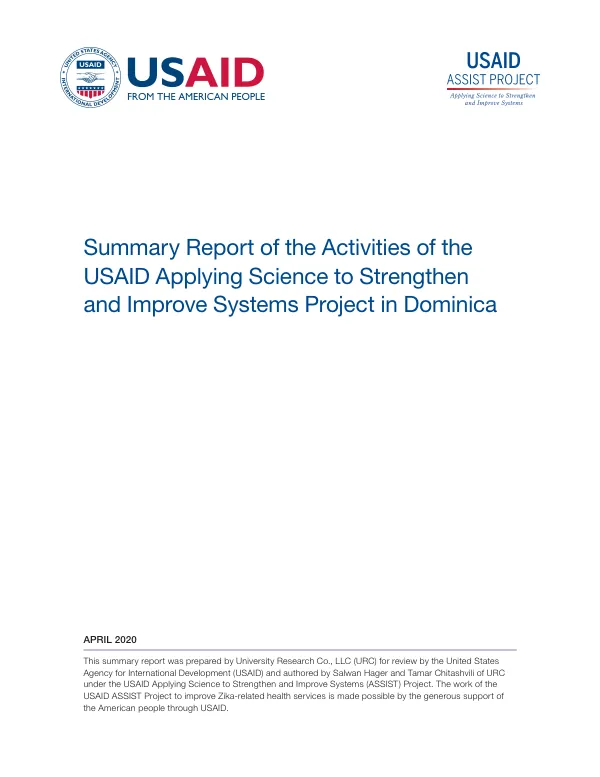
Summary Report of the Activities of the USAID Applying Science to Strengthen and Improve Systems Project in Dominica
Sign inENCOMPASS, LLC
Summary Report of the Activities of the USAID Applying Science to Strengthen and Improve Systems Project in Dominica
The USAID Applying Science to Strengthen and Improve Systems (ASSIST) Project in Dominica aimed to improve Zika-related health services.
2020 · 74 pages
Sign in to readA free account is required to download.
Abstract
The project provided short-term technical assistance (STTA) over a period of approximately 18 months, supporting 50 functioning health facilities to carry out quality improvement (QI) activities. The primary goal was to increase the number and proportion of infants affected by Congenital Syndrome associated with Zika virus (CSaZ) who received quality care. The project focused on improving the quality of care for infants and children affected by CSaZ, with a particular emphasis on neurodevelopmental surveillance and clinical management. ASSIST staff worked closely with local counterparts, including the Ministry of Health (MOH) and facility staff, to implement quality improvement activities. The project also collaborated with global and regional partners, including the American Academy of Pediatrics, Caribbean Regional Midwives Association, and WI-HER, LLC, to support implementation and promote institutionalization and sustainability. Improvements in quality of care were observed in several areas, including the use of a revised neurodevelopmental surveillance tool in child health records and the implementation of a clinical management decision tree for infants born during periods of Zika transmission. Additionally, the project supported the development of knowledge products, such as job aids and guides, to facilitate the implementation of quality improvement activities. The project also focused on promoting institutionalization and sustainability, with strategies implemented at the MOH level and through linkages with other sectors. The Zika Technical Working Group (TWG) was established to provide a platform for stakeholders to share knowledge and best practices, and a Sustainability and Transition Policy Meeting was held to discuss the long-term sustainability of the project's interventions. The project also addressed gender integration activities, with a focus on promoting equal access to quality care for women and children. The project supported the development of a job aid for measuring, classifying, and documenting head circumference, which was identified as a critical indicator for CSaZ. The results of the project were positive, with improvements observed in several areas, including the quality of care for infants and children affected by CSaZ. The project also supported the development of knowledge products and job aids to facilitate the implementation of quality improvement activities. The project's focus on institutionalization and sustainability ensured that the interventions would be sustained beyond the project's duration. The project's core team, led by Salwan Hager and Tamar Chitashvili, worked closely with local counterparts and global partners to implement the project's activities. The project was funded by the American people through the USAID Global Health Office, Office of Health Systems, and was managed by University Research Co., LLC (URC) under the terms of Cooperative Agreement Number AID-OAA-A-12-00101. The project's success was due in part to the strong collaboration between ASSIST staff, local counterparts, and global partners. The project's focus on quality improvement and institutionalization ensured that the interventions would be sustained beyond the project's duration, and the development of knowledge products and job aids facilitated the implementation of quality improvement activities. The project's results demonstrate the importance of investing in quality improvement and institutionalization to improve health outcomes for vulnerable populations.