CAMP DRESSER AND MCKEE, INC. (CDM)
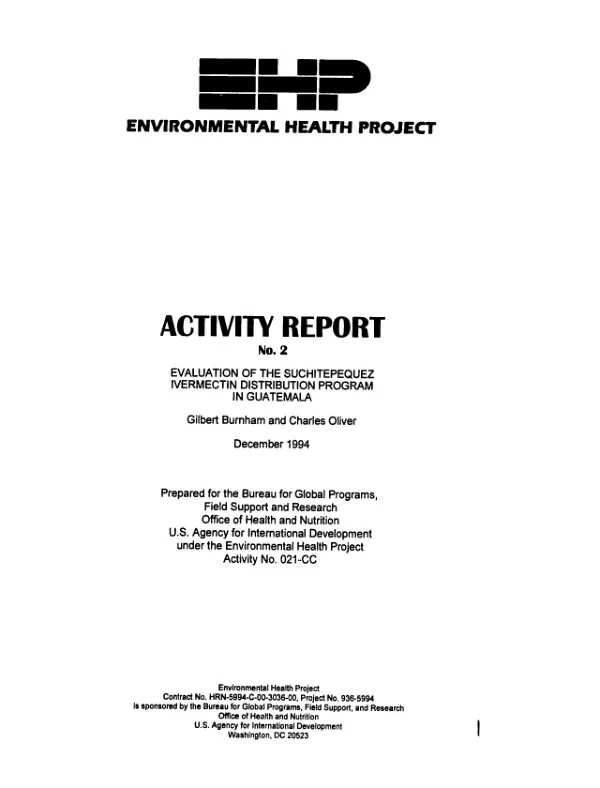
Evaluation of the Suchitepequez ivermectin distribution program in Guatemala
Evaluates project to reduce the intensity of onchocercal infections in the Suchitepequez Province in Guatemala.
Burnham, Gilbert|Oliver, Charles · 1994
Sign in to readA free account is required to download.
Abstract
Evaluation covers the period 1992-12/94. Overall, the Suchitepequez Ivermectin Distribution Program and its successor, the National Plan for the Elimination of Onchocerciasis, were a success. In 4 rounds of treatment, the program distributed 130,289 doses of ivermectin to persons living in isolated locations where onchocerciasis is hyperendemic. It demonstrated that a collaborative program, supported by organizations very different in nature, can work. In addition, the program showed that ivermectin can be distributed in Guatemala without fear of serious adverse physical reactions. Community-based distributors were effective agents for a public health mass-distribution program. This experience could be applied to other health activities, such as tuberculosis or helminth control. The program documented the prevalence and intensity of onchocerciasis in a variety of geographic areas through an extensive epidemiology and health information system. Perhaps the program's most important accomplishment is that it stimulated the development of a National Plan for the Elimination of Onchocerciasis in Guatemala (NPEO). At the end of the second year, the Suchitepequez project became the basis for the National Plan, using its basic infrastructure. Lessons learned from the first 2 years helped in the subsequent reorganization of the program. However, the project did have significant problems. Leadership difficulties impaired the efficiency of the project and reduced its effectiveness. Communication between participating organizations was universally identified as the weakest area, and prevented effective team work. Another problem involved the health information system, which collected too much information. Much of this information was not processed or communicated in a way that was useful for project decision-making. The problem lay in both the form of its dissemination and the capacity of managers to interpret and use it. Other difficulties included the following. (1) The full potential of community-based distributors was not realized. (2) Supervision and in-service training for the brigadistas was difficult. (3) Training materials for community-based distributors were insufficient. (4) Ivermectin delivery was overly centralized; many treatment personnel were not living near or in the treatment area and the project had to depend on brigadistas. In addition, the integration of diagnostic, motivation, and treatment elements was slow. (5) Quality control measures were instituted late and incompletely. (6) Community mobilization and awareness about onchocerciasis could have been stronger; only minimal educational materials were available, and attempts to sensitize finca (agricultural estate) managers and owners about onchocerciasis seemed weak. Had funds allowed, an entomological component to study the effects of a mass-distribution program on transmission of infection would have been most instructive. At the conclusion of this report, various recommendations are made concerning approaches to strengthening the National Plan, which will begin functioning in a new structure shortly. (Author abstract)