USAID DEC
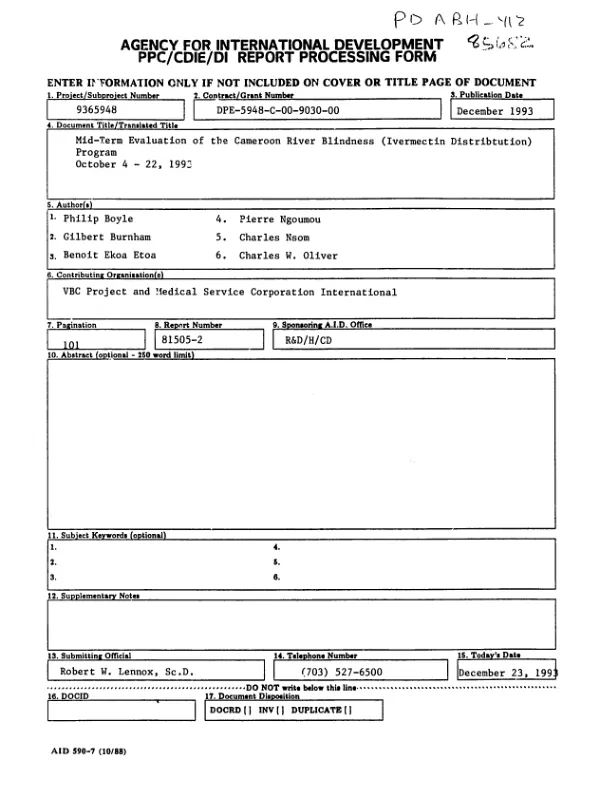
Mid-term evaluation of the Cameroon river blindness (ivermectin distribution) program, October 4-22, 1993
Sign inMEDICAL SERVICE CORP. INTERNATIONAL
Mid-term evaluation of the Cameroon river blindness (ivermectin distribution) program, October 4-22, 1993
Interim evaluation of a project, implemented by the International Eye Foundation (IEF), in Cameroon's Dja et Lobo Division to test a model of cost-effective, sustainable distribution of ivermectin for onchocerciasis treatment through the rural primary health care (PHC) system.
Boyle, Philip|Burnham, Gilbert · 1993
Sign in to readA free account is required to download.
Abstract
The evaluation covers the period 9/91-10/93. IEF had serious difficulties in carrying out surveys, training, and supervisory visits due to safety, communications, and logistical problems caused by the social turmoil associated with the 10/92 Cameroonian presidential elections. Remarkably, however, it was still able to produce significant accomplishments, and, except for the coverage rate for ivermectin distribution, has the potential to achieve all objectives by the project completion date. Overall, and in spite of the unfortunate timing of the project, the integration of ivermectin delivery into the PHC system is unique, and presents a cost-effective, sustainable, and replicable model for disease prevention and control. IEF's accomplishments included: (1) intensive and rapid epidemiologic assessments to establish the endemicity of onchocerciasis in the division of Dja et Lobo; (2) completion of a KAP survey as a basis for delivering appropriate health education materials and messages; (3) development of delivery protocols, materials, and methods for tracking project progress; (4) treatment of 17,800 persons for onchocerciasis during the first round of ivermectin distribution; and (5) training/supervision of more than 100 health personnel in all Ministry of Public Health (MOPH) facilities in Dja et Lobo. However, there were numerous weaknesses: the coverage rate for the first round of ivermectin distribution was about 20% of the eligible population, well below the goal of 80%; consolidation and analysis of data were hindered by a malfunctioning computer and poorly designed onchocerciasis treatment forms; the use of ophthalmic methods for establishing prevalence of blindness to correlate with onchocerciasis was not a successful approach; and health education messages concerning guidelines for exclusion from treatment and protocols for handling adverse reactions require reinforcement and standardization. Lessons learned included the following. (1) A system which relies solely on passive distribution at health facilities is unlikely to produce high coverage. (2) It is important to make sure that the target PHC system is ready before beginning actual distribution of drugs; the degree of coverage is a function of capabilities of the PHC system. (3) Where public understanding of onchocerciasis and the availability of treatment are low, concerted efforts are needed to develop demand for treatment. (4) The use of PVOs as implementing organizations has both advantages and disadvantages in the African context, where public sector health delivery is usually less efficient than PVO methods. A PVO may be unwilling to give up its own efficient system, even if it accepts local integration in principle. (5) An information system should be viable in non-computerized form before attempts are made to computerize it. (6) It is essential that implementing PVOs establish a strong in-country presence. (7) Roles and responsibilities of the PVO, host government institution, and project sub-contractors must be clearly established before the inception of the project.